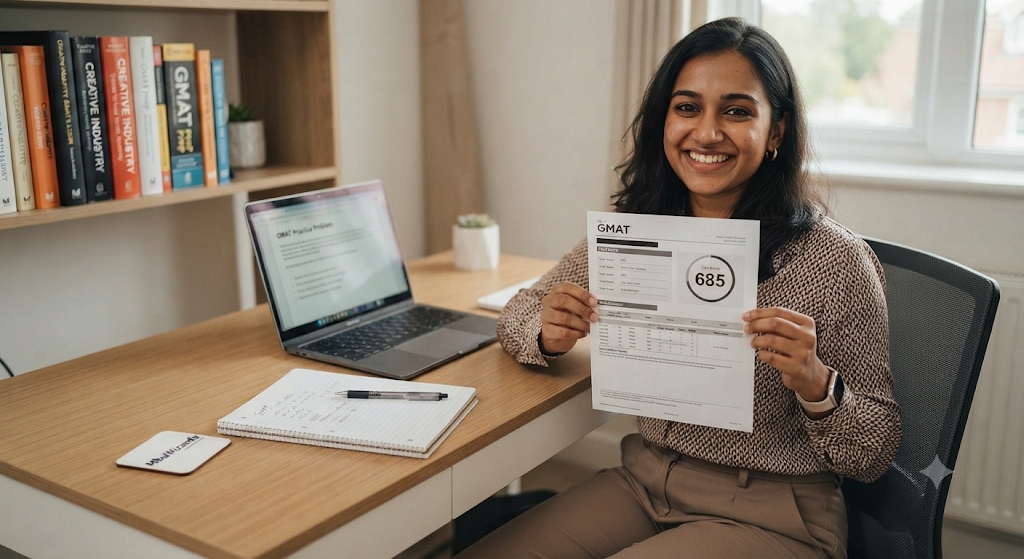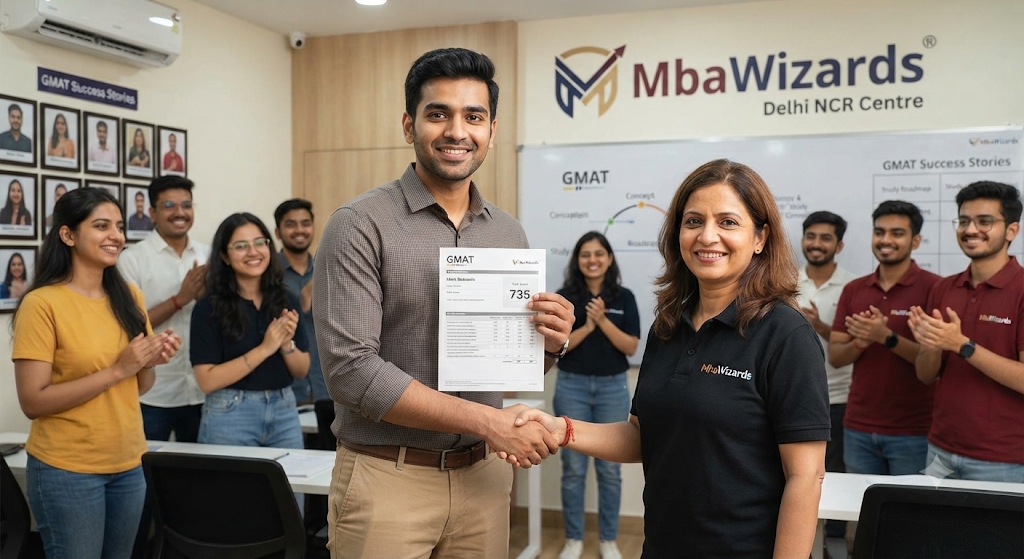
Conquering Verbal Phobia: How I Scored V47 on the GMAT with MbaWizards
From verbal phobia to a V47 on the GMAT. See how personalised coaching at MbaWizards in Delhi NCR helped a student beat SC, CR and RC anxiety.
Introduction: The Day I Admitted I Was Afraid of Verbal
Most GMAT aspirants talk about quant anxiety. Hardly anyone talks about the quiet dread that some of us feel when we open a Sentence Correction question, or when a dense Reading Comprehension passage fills the screen. I was one of those people. For a long time, I believed I was simply 'not a verbal person', and that no amount of practice would change it.
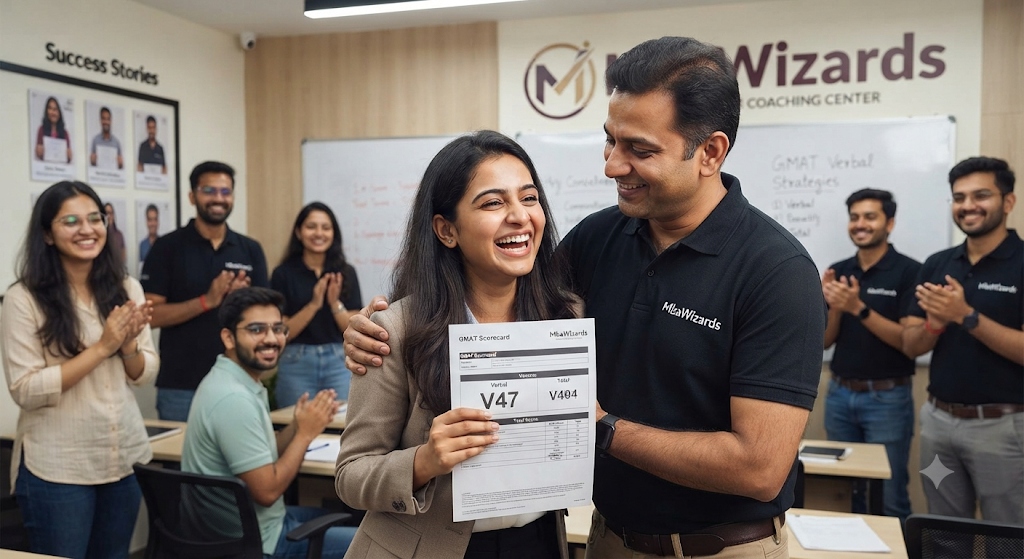
Today I have a **V47** on my GMAT scorecard, and I still sometimes look at it twice to make sure it is real.
This is the honest story of how I went from verbal phobia to an official **GMAT verbal 47**, what I did differently, which mistakes I made along the way, and why joining MbaWizards GMAT coaching became the turning point of my entire MBA preparation. If you are a working professional, a final-year student or a career switcher in Delhi, Gurgaon, Noida or anywhere else in India who feels stuck in the same place I was, I hope this helps you.
Where It All Began: A Fear That Felt Impossible to Beat
My journey began at a point when my verbal fear felt bigger than my ambition. I had decided that an MBA was the next step in my career, and I knew a strong GMAT score would open doors to elite business schools like ISB, INSEAD, London Business School, and IIM Ahmedabad PGPX. But every time I sat down with a verbal practice set, something inside me tightened.
Sentence Correction felt like a minefield. Every option looked almost the same, and I could never explain why one was right and the others were wrong. Critical Reasoning felt like a trick, where the answer I chose always seemed to be the one the test-makers had designed as a trap. Reading Comprehension was the worst. I would reach the end of a passage and realise I had read every word but absorbed nothing.
The real problem was not my English. I could write emails, present to clients and read long reports at work. The real problem was fear. The more I worried about getting questions wrong, the more mistakes I made, and the more mistakes I made, the more my fear grew. It was a vicious loop, and I could not find the exit by myself.
I tried the usual things. I bought popular books, watched free YouTube videos, and took random practice tests. My scores moved a little, but they never moved enough, and my confidence kept dropping. That was the moment I understood that I did not need more material. I needed a better method, and someone who could guide me through it.
Why Verbal Feels So Much Scarier Than Quant
It helps to understand why verbal creates so much anxiety, because once you understand it, it becomes easier to manage.
In quantitative reasoning, there is usually one clear numerical answer, and you can verify your work. In verbal, you are often choosing the best option from several imperfect ones. That ambiguity makes many students feel unsafe, because they cannot prove their answer is right with mechanical certainty.
There are a few key reasons why verbal feels harder than it needs to be:
- **Time pressure feels sharper:** A dense RC passage can eat up 3 to 4 minutes before you have even attempted the first question.
- **Intuition is not enough:** Many students rely on what 'sounds right' to the ear. But the GMAT tests rigorous logical rules and precise semantic relationships, not casual colloquial ear.
- **Wrong answers are designed to be tempting:** Each wrong option usually contains a fatal flaw, but it is wrapped in familiar, polished language that looks convincing.
- **One bad question shakes your confidence:** On an adaptive computer test, an early mistake can make you second-guess your reasoning on the next five questions.
“When I finally understood these points, my fear began to look less like a personal weakness and more like a normal reaction to a tricky test design. That change in thinking was the first real step forward.”
— MbaWizards V47 Alum
The Turning Point: Walking into MbaWizards
When I enrolled at MbaWizards, I honestly expected another standard coaching factory: a massive batch, a fixed generic syllabus, and very little attention for individual students. What I found was completely different, and it surprised me in the best way.
From the very first interaction, I felt encouraged instead of judged. The instructors did not treat my verbal fear as something silly. They treated it as an analytical challenge that was completely solvable. That alone changed how I walked into every class afterward.
The instructors at MbaWizards Delhi NCR have a rare mix of deep subject expertise (IIT & IIM alumni faculty) and real empathy. They know the GMAT deeply, but they also understand what it feels like to sit in front of a screen with a ticking clock and a blank mind. They could break down complicated verbal concepts into small, simple steps, and they never made me feel slow for asking the same question twice.
Slowly, I stopped dreading verbal sessions. In fact, I started looking forward to them.
Personalised Coaching: The Biggest Difference-Maker
If I had to point to one thing that made the largest difference in my preparation, it would be personalisation. Explore our GMAT preparation methodology to see how individual diagnostics work.
My instructors took time to understand how I learn. Some students learn best by reading explanations, others by solving high volumes of questions, and others by discussing ideas aloud. I learn best when I can see a structural pattern and then test it myself. My instructors noticed this and adjusted their teaching around it, instead of forcing me into a one-size-fits-all approach.
Here is what personalised coaching looked like in practice:
- **A proper diagnostic:** We began by identifying exactly where I was losing marks: not just 'verbal is weak', but which specific question types, which sub-topics and which trap patterns were repeating.
- **Targeted feedback:** After each practice set, I received specific comments on my reasoning process, not only on the final answer. A wrong answer became an instructive lesson instead of a disappointment.
- **One-on-one sessions:** When a concept was not clicking, I could sit down with an instructor and work through it at my own pace until it became second nature.
- **Interactive exercises:** Live classes were not passive lectures. We solved questions together, discussed why options were wrong, and learned to defend our choices with evidence.
- **Regular adjustments:** My study plan changed as I improved. When one area became strong, we shifted our energy to the next weakness using the AI Study Planner.
Sentence Correction: From Guessing to Reasoning
Sentence Correction was where my fear was strongest, so it was also where my progress felt most satisfying.
Earlier, I used to read the sentence, pick the option that 'sounded best' and move on. Sometimes I was right, but I could never repeat it consistently, because I did not have a repeatable method. With help from my instructors, I replaced intuition with a clear, algorithmic process.
Here is the approach that worked for me:
- **Read the original sentence once, carefully:** Look for obvious signals first, such as a verb, a pronoun or a modifier that may be misplaced.
- **Spot the split:** Look at where the answer options differ vertically. Those differences point to exactly what grammar concepts the question is testing.
- **Eliminate by rule:** Check one issue at a time: subject-verb agreement, parallelism, modifier placement, verb tense, or pronoun reference. Cross out options that break any hard grammatical rule.
- **Check meaning last:** Once grammar is clean, make sure the remaining option says what the author logically intended without ambiguity or distortion.
- **Review every mistake:** I kept an error log with the specific rule I missed, so the same trap never caught me twice.
The most important change was that I started to trust the process over my feelings. Even when a sentence sounded strange, if it followed the rules, I learned to accept it. My accuracy improved quickly once I stopped relying on the ear alone.
Critical Reasoning: Learning to Think Like the Test-Maker
Critical Reasoning used to feel like a trap, but it began to feel like a puzzle once I learned the structure behind it.
Every CR question follows a predictable logical architecture. There is an argument, which has a conclusion supported by premises, and there is usually an unstated assumption connecting the two. Once I learned to break arguments into those parts, the questions became much more predictable.
My method looked like this:
- **Read the question stem first:** Knowing whether I needed to strengthen, weaken, find an assumption or draw an inference helped me read the stimulus with purpose.
- **Find the conclusion:** If I could not state the conclusion in my own words, I read the argument again. The conclusion is the heart of the argument.
- **Identify the logical gap:** Most arguments have a gap between evidence and conclusion. That gap is where the right answer lives.
- **Predict before looking at options:** Even a rough prediction in my head protected me from tempting wrong answer choices.
- **Eliminate extremes and out-of-scope choices:** Many wrong options are too broad, too strong, or simply irrelevant to the core thesis.
Practising this in live sessions, with an instructor challenging my reasoning, built the kind of logical discipline I could never have built alone.
Reading Comprehension: From Reading Words to Understanding Ideas
Reading Comprehension was the section that taught me the most about myself.
My mistake was simple: I read passages as if I had to memorise them. In reality, the GMAT does not expect you to remember facts. It expects you to understand the structure, the main idea and the author's tone, and to know where to look when a detail question appears.
Here are the habits that changed my RC performance:
- **Read for the big picture:** I focused on why the author wrote the passage, what the main thesis was, and how each paragraph supported it.
- **Make a quick mental map:** After each paragraph, I summarised its function in a few words in my head, such as 'problem', 'old theory', or 'new evidence'.
- **Notice the tone:** Words like 'however', 'unfortunately', or 'surprisingly' reveal the author's attitude, which is frequently tested in inference questions.
- **Return to the text:** For detail questions, I never answered from memory. I went back to the passage and confirmed my answer against the exact wording.
- **Build a reading habit:** I began reading long-form articles in *The Economist*, *Scientific American*, and *The Financial Times* daily, so dense writing stopped feeling intimidating.
With regular practice and gentle correction from my instructors, passages that once felt overwhelming became manageable, and then even interesting.
The Power of Community: I Was Never Alone
One thing nobody tells you about GMAT preparation is how lonely it can feel. When you are battling self-doubt, it is easy to believe that everyone else is doing better than you.
At MbaWizards, I was surrounded by fellow students who shared the same struggles and the same dreams. Some were working professionals studying after long 10-hour office shifts in Gurgaon Cyber City and Noida. Some were final-year college students. Some were aiming for top business schools in India (ISB, IIM Bangalore, IIM Ahmedabad), and others for international MBA programmes in the US, Europe, and Asia (like the CityUHK MBA Hub). But all of us understood the pressure, and that shared understanding made a huge difference.
We organised collaborative study sessions where we solved questions together and explained our reasoning to each other. Teaching a concept to someone else turned out to be one of the best ways to master it. Peer support groups gave me a safe space to admit when I was struggling, and online forums allowed us to exchange ideas, share resources and ask questions at any hour.
Watching others push through their own fears gave me strength on days when I felt like quitting. The collective determination of the group became my fuel.
My Preparation Roadmap: How the Months Unfolded
My preparation took several months of consistent effort. Every student's timeline is different, but here is a rough picture of how my journey was structured:
| Phase | Timeline & Focus Area | Key Deliverables & Milestones |
|---|---|---|
| **Phase 1: Foundation** | Weeks 1 to 3: Diagnostics & Basics | Diagnosed weak areas; rebuilt grammar rules, argument anatomy, and structural reading habits without a timer. |
| **Phase 2: Concept Building** | Weeks 4 to 7: Untimed Accuracy | Worked through each question type with guided practice; created a 4-bucket error log for every missed question. |
| **Phase 3: Timed Practice** | Weeks 8 to 11: Pacing Calibration | Introduced sectional time limits; mastered the 1:45 minute pacing rhythm and learned to guess and move on hard questions. |
| **Phase 4: Full-Length Tests** | Weeks 12 to 14: Mock Diagnostics | Took official GMAC full-length practice tests under simulated exam conditions; conducted 3-hour forensic error reviews. |
| **Phase 5: Final Polish** | Final 2 Weeks: Mental Calibration | Focused on stamina, mindset, sleep discipline, and error log reviews rather than cramming new material. |
Managing Test-Day Nerves
Even with strong preparation, test day can bring back old fears. I made sure I had a few simple habits in place:
- **Slept well the night before:** I avoided last-minute cramming and gave my brain 8 full hours of rest.
- **Reached the centre early:** I arrived at the test centre 45 minutes before check-in so I did not start the exam feeling rushed or stressed.
- **Treated every question as a fresh start:** I refused to carry frustration from a difficult question into the next one.
- **Used breaks to reset:** I drank water, did light breathing exercises, and wiped the slate clean during the scheduled breaks.
- **Trusted my training:** I reminded myself that I had practised this dozens of times, and that the exam was simply one more practice session.
“That calm, practised mindset was the result of months of systematic support, not luck.”
— MbaWizards V47 Alum
The Moment It Became Real: V47
After months of dedicated preparation and steady support from MbaWizards, I achieved a **V47 on the GMAT**. This was a result that once felt unimaginable, back when I could barely finish a verbal practice set without feeling anxious.
What meant more than the number was what it proved. It proved that verbal ability is not a fixed talent. It is a trainable skill that anyone can build with the right method, the right guidance and enough patience. My perseverance and determination were validated, and the score opened doors to academic and scholarship opportunities that had previously felt out of reach. Check out more GMAT Topper success stories from MbaWizards.
Practical Tips If You Fear the GMAT Verbal Section
If you see yourself in my story, here is what I would suggest, based on my own experience:
- **Accept the fear, then work on it:** Fear is normal. Treat it as a signal to prepare better, not as proof that you cannot succeed.
- **Fix your method before your speed:** Accuracy built on a strong, repeatable process will naturally become fast with time.
- **Keep an error log:** Write down every mistake and the specific reason behind it. Review it weekly.
- **Read widely:** Newspapers, business magazines and long-form scientific essays all train your brain for GMAT-style prose.
- **Practise with explanations:** Never move on from a question without understanding why the right answer is right and the wrong ones are wrong.
- **Take full-length mocks:** They build psychological stamina and teach you how to handle pressure.
- **Get expert feedback:** A good mentor can spot patterns in your mistakes that you will never see yourself.
- **Look after yourself:** Sleep, exercise and breaks are an essential part of preparation, not wasted study time.
Why I Recommend MbaWizards for GMAT Coaching
Looking back, I can clearly see what made my experience at MbaWizards different. It was not only the quality of the material. It was the people and the approach:
- **Expert and empathetic instructors:** Mentors with decades of experience who make complex verbal concepts simple.
- **Personalised guidance:** Coaching that adapts to each student's learning style, diagnostic baseline, and target b-schools.
- **A supportive community:** Peer cohorts who motivate and challenge each other every day.
- **A structured, proven approach:** Frameworks that have consistently produced 705+ scores (99th percentile) across batches.
- **Flexible learning options:** In-person classroom centres in Gurgaon (Sector 14 & Cyber City), Noida, and Delhi, plus comprehensive live interactive online batches.
If you are searching for GMAT coaching in Delhi NCR, whether in Delhi, Gurgaon, Noida or Faridabad, or if you prefer online GMAT coaching across India, MbaWizards is a trusted partner for your journey. Explore our Career Intelligence Suite and start your transformation today.
Frequently Asked Questions
Q: Can I really improve my GMAT verbal score if I am weak in English?
Yes. The GMAT tests specific logical rules and reasoning patterns, which can be learned systematically. Many students who start with low verbal confidence improve significantly with structured practice, error analysis, and expert faculty feedback.
Q: How long does it take to reach a V47?
It depends on your starting diagnostic level, daily study time and consistency. For many students, a focused plan over 3 to 4 months, with regular practice and review, makes a big difference. Your MbaWizards mentor can help you build a realistic roadmap.
Q: Which verbal section is the hardest for most students?
This varies. Some students struggle with Sentence Correction rules, others with Critical Reasoning assumption logic, and others with Reading Comprehension pacing and stamina. A personalized diagnostic test helps you identify your specific weak spots.
Q: Is coaching necessary for GMAT verbal?
Coaching is not mandatory, but personalised mentoring can save months of trial and error, correct flawed reasoning models early, and provide the psychological confidence that self-study often lacks.
Q: How does MbaWizards help students with verbal anxiety?
Through personalized diagnostics, one-on-one strategy reviews, interactive problem-solving classes, and a supportive peer community, students build both analytical mastery and test-day mental resilience.
Q: Does MbaWizards offer GMAT coaching in Delhi NCR?
Yes, MbaWizards operates dedicated coaching centres across Delhi NCR (including Gurgaon and Noida) and delivers live interactive online classes for students across India and abroad.
Q: What should I do daily to improve my verbal skills?
Practise 10 to 15 targeted questions daily across question types, log and review every single mistake, and read at least one 1,500-word long-form editorial (from The Economist or Scientific American) to build comprehension stamina.
Ready to Start Your Own Verbal Success Story?
If verbal fear has been holding you back, you do not have to face it alone. Book a free demo class or a personalized diagnostic session with MbaWizards, and take the first step toward your own GMAT breakthrough.
**Call / WhatsApp:** +91 98115 66490 | **Centre Locations:** Delhi NCR (Gurgaon Sector 14 & Cyber City, Noida, Delhi) | **Website:** mbawizards.co.in | Schedule a Free Diagnostic Session
*Disclaimer: Individual results vary and depend on effort, starting baseline and consistency. Scores mentioned reflect one student's verified experience.*
Attempt Official CAT & GMAT Mock Tests
Benchmark your score under authentic computer-based algorithms, get instant sectional percentiles, and uncover critical time traps before test day.
CAT Full-Length Mock Test
Simulate authentic TCS-iON exam conditions with 66 questions, 120-minute countdown timers, negative marking (-1 / +3), and instant AI percentile analytics.
- ✓Authentic TCS-iON CBT screen & calculator
- ✓Instant All-India Percentile & AIR projection
- ✓AI mistake taxonomy (Concept vs Calculation vs Speed)
- ✓Curated by 99.8+%ile IIT Roorkee alumni mentors
GMAT Focus Adaptive Mock
Experience real computer-adaptive algorithms, authentic question weighting, 3-edit review feature, and score calibration on the 205–805 official scale.
- ✓True Item-Response Theory adaptive question routing
- ✓Full coverage: Quant, Verbal & Data Insights
- ✓Instant 205–805 score & sectional percentiles
- ✓Deep question-by-question timing & accuracy log
Accelerate Your Score with MBA Wizards AI Diagnostic Tools
Proprietary adaptive test algorithms, speech cadence analytics, and behavioral simulation trained on 25+ years of IIM and 700+ GMAT mentorship data.
AI CAT Mock Interviewer
Adaptive IIM PI simulation with real-time video evaluation, speech cadence analytics, and faculty question banks.
Launch CAT Interviewer ↗AI GMAT Interviewer
Simulate high-stakes behavioral & leadership interviews for ISB, IIM PGPX, and global M7 business schools with instant scoring.
Try GMAT Interviewer ↗GMAT Adaptive Mock Tests
Authentic item-response theory algorithms, 3-question edit feature, and deep sectional error logs for 705+ targeting.
Take Adaptive Mock ↗1-on-1 Faculty Mentorship
Personalized diagnostic strategy consultation with IIT Roorkee alumni faculty to audit your test baseline and target intake roadmap.
Aiming for 705+ on GMAT or 99th %ile in CAT?
Schedule a personalized 1-on-1 strategy call with our Chief Academic Mentor (IIT Roorkee Alum) and get a diagnostic roadmap tailored to your target intake.