AP Exam Planner: Grade-by-Grade AP Subjects Plan for Grades 9 to 12
Plan AP subjects for Grades 9–12 with this AP exam planner for Indian students: best AP courses by grade, exam calendar, workload and SAT/UCAT timing.
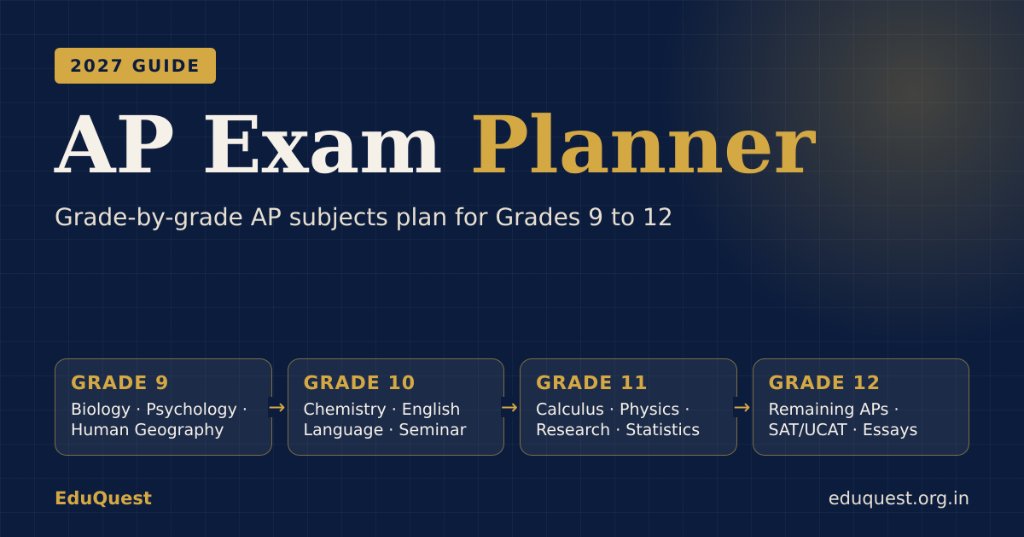
An **AP exam planner** is a year-by-year map that tells a student which Advanced Placement (AP) subjects to take in Grade 9, 10, 11 and 12, and when to sit each exam. For Indian students aiming at universities in the US, Canada, the UK, Singapore or Europe, that map matters more than most families realise. AP subjects chosen at random create a heavy, unfocused transcript. AP subjects chosen with a plan build a clear academic story that admissions officers can read in seconds.
At EduQuest, we meet this problem every year. A Grade 9 student takes five APs because a friend did. Another waits until Grade 11 and then has two years of content to cover in one. Both situations are avoidable. This comprehensive guide gives you a simple, grade-wise AP exam planner for students who are entering or currently in Grade 9–10, with sample pathways for medicine, economics, computer science and finance.
AP Basics Every Indian Family Should Know
Before you plan, these core facts keep expectations realistic:
- **What AP is:** AP is a College Board programme of college-level courses and exams. Exams are scored from 1 to 5, and a 3 or above is generally treated as a passing score.
- **When the exams happen:** The 2027 AP exams run from **3 to 14 May 2027**, over two weeks. Late-testing slots run from **17 to 21 May 2027**. Official scores are released in July.
- **Ordering deadline:** For 2027 exams, the final standard ordering deadline for full-year courses was 13 November 2026. Orders after that carry a late fee of 40 US dollars per exam, so students who have not registered should speak to their school AP coordinator or an authorised test centre immediately.
- **Where AP counts most:** US and Canadian universities use AP for credit, placement and as proof of rigour. Universities in the UK, Singapore and Europe usually give more weight to board results, but strong AP scores still support a subject-specific application. Always check each university's own policy.
- **AP Seminar and AP Research:** These two courses form the AP Capstone programme. Independent self-study is not permitted for either, and AP Research requires AP Seminar first. A student can take them only through a school that offers AP Capstone.
“These rules shape the plan below. For example, if your school does not offer AP Capstone, the Grade 10 Seminar and Grade 11 Research steps need an approved alternative, such as an independent research project, a science fair or a published paper.”
— EduQuest Academic Advisory Board
The Core AP Exam Planner for Grades 9 to 12
The plan below assumes the student is entering or already in Grade 9 or 10 now. It adds one or two meaningful APs each year, saves the heaviest quantitative subjects for Grade 11, and keeps Grade 12 for gaps, test prep and applications.
| Grade | AP Subjects to Plan | What the Year is For |
|---|---|---|
| **Grade 9** | AP Biology, AP Psychology or AP Human Geography | Learn the AP style of reading, writing and exam timing with subjects that match a first-year load |
| **Grade 10** | AP Chemistry, AP English Language & Composition, AP Seminar | Build lab science, argument writing and the research habit |
| **Grade 11** | AP Calculus AB/BC, AP Physics 1/2, AP Research (if Seminar was taken), AP Statistics (optional) | Add quantitative depth and an independent research project |
| **Grade 12** | Any remaining APs, plus UCAT/SAT prep and application essays | Close gaps, lift scores and finish applications |
The logic is simple. Grade 9 builds the habit. Grade 10 builds range, by pairing a science with a writing course. Grade 11 builds depth, because Calculus, Physics and Research are the courses admissions readers look at first for STEM and medicine applicants. Grade 12 is the finishing year: only a few new APs, but a lot of test and essay work.
Grade 9: Start with One or Two AP Subjects
Grade 9 is a testing ground. The goal is not a long AP list. The goal is to learn how an AP course works: heavy reading, short written answers, data and graph questions, and a May exam that covers a full year. Choose one subject, or two if the student is comfortable.
- **AP Biology:** This is the best fit for students aiming at medicine, biotechnology or life sciences. It covers evolution, cell structure and energy, genetics, and how organisms interact. It is a demanding first AP, because it mixes memory with data analysis and lab reasoning, so it suits students who are already strong in science.
- **AP Psychology:** This is one of the most accessible APs. It covers how people think, learn, remember and behave. It is useful for medicine and neuroscience profiles, and for economics students interested in behavioural economics. The workload is mostly reading and vocabulary, so it is a safe first AP.
- **AP Human Geography:** This subject looks at population, culture, cities, migration and economic patterns. It is a gentle introduction to AP-style analysis, and it connects well to economics, public policy and international relations.
**How to choose:** A future doctor should lean towards AP Biology or AP Psychology. A future economist or policy student should consider AP Human Geography or AP Psychology. A student who is unsure should start with AP Psychology or AP Human Geography, then add AP Biology in Grade 10 if the first year goes well.
**What else Grade 9 needs:** At EduQuest, Grade 9 also carries SAT and PSAT preparation over roughly six to seven months, and the first layer of profile building: a club, a reading habit, and an initial project. AP is one part of that, not the whole.
Grade 10: Add a Lab Science, a Writing Course and Research
Grade 10 is where the planner starts to show a direction. The suggested list is AP Chemistry, AP English Language & Composition and AP Seminar. A student does not need to take all three. Two well-prepared exams are better than three rushed ones.
- **AP Chemistry:** This is a college-level general chemistry course. It covers atomic structure, bonding, reactions, equilibrium, thermodynamics and kinetics. It needs strong algebra and steady practice with problems, and it is a core subject for medicine, pharmacy and chemical engineering profiles.
- **AP English Language and Composition:** This course trains students to analyse rhetoric, build arguments and synthesise sources. It helps every other subject, and it directly improves the essays that students write for university applications. Indian students who are strong in science but cautious with writing often gain the most from it.
- **AP Seminar:** This is the first half of the AP Capstone programme. Students work in teams and alone, read research articles, write evidence-based arguments and present them. It cannot be self-studied. If the school offers AP Capstone, Grade 10 is the ideal year to start, because AP Research follows in Grade 11. If the school does not offer it, plan a research paper drafting and publishing project or a mentored paper instead.
**SAT timing:** In Grade 10 the focus shifts from the PSAT to structured SAT preparation, again over about six to seven months. Keep the AP load and the SAT load realistic together.
Grade 11: The Heaviest and Most Important Year
Grade 11 carries the subjects that universities weigh most. It is also the year when board exams, SAT sittings and AP courses all compete for the same hours. Plan it first, and plan it honestly.
- **AP Calculus AB or BC:** AB covers limits, derivatives and integrals, roughly a first college calculus course. BC covers all of AB and adds series, parametric and polar functions, so it suits students aiming at engineering, computer science, physics or quantitative finance. Students heading to medicine or economics can usually choose AB without losing anything.
- **AP Physics 1 or 2:** Both are algebra-based. Physics 1 covers mechanics, waves and basic circuits. Physics 2 covers fluids, thermodynamics, electricity, optics and modern physics. Many students take Physics 1 first and Physics 2 later. A student who will study physical sciences or engineering should also look at AP Physics C in Grade 12, which needs calculus.
- **AP Research:** This follows AP Seminar and is the second half of AP Capstone. The student chooses a topic, runs an independent investigation, writes an academic paper of about 4,000 to 5,000 words and defends it in a presentation. It is one of the few AP courses that produces something a student can discuss in an interview and in application essays.
- **AP Statistics (optional):** This course teaches data collection, probability and inference. It is useful for medicine, economics, psychology and data science, and it is among the more manageable AP courses next to Calculus.
**Alongside AP:** Advanced SAT preparation over about six to seven months, plus profile building for medicine / economics and STEM. In practice this means choosing a few activities that match the intended course and going deeper, instead of collecting many small certificates.
Grade 12: Finish Strong, Do Not Start New Mountains
Grade 12 should have a lighter AP load. Add only the remaining subjects that fit the intended course, such as AP Microeconomics, AP Macroeconomics, AP Physics C or AP Calculus BC, and use the rest of the year for what decides admissions.
- **UCAT or SAT preparation:** UK medicine and dentistry applicants sit the UCAT, normally in the summer before applying. US-bound students finalise their SAT scores. Check each test's current dates and registration windows.
- **Application essays and statements:** These take longer than most students expect. At EduQuest, Grade 12 is a six-month, ongoing phase covering admission guidance, statements of purpose, letters of recommendation, college selection and scholarship applications. Explore our study abroad guidance framework.
- **Deadlines:** UCAS applications for medicine, dentistry and Oxbridge close in mid-October. US early rounds usually close around 1 November, and regular rounds close in early January.
“A point many families miss: AP exams are held in May, after most university decisions are made. Applications therefore rely on the AP courses listed in the school profile and on predicted or earlier scores. Strong earlier APs (from Grades 9 to 11) make Grade 12 much safer.”
— EduQuest Admissions Advisory Panel
AP Subject Pathways by Career Goal
The core plan is a base. The right AP subjects change with the degree the student wants. This table shows four sample pathways. Use it as a starting point, then adjust it to the school's offerings and the student's strengths.
| Goal | Grade 9 | Grade 10 | Grade 11 | Grade 12 |
|---|---|---|---|---|
| **Medicine and Life Sciences** | AP Biology or AP Psychology | AP Chemistry, AP English Language, AP Seminar | AP Calculus AB, AP Physics 1/2, AP Research, AP Statistics (optional) | Remaining APs, UCAT/SAT, essays |
| **Economics** | AP Human Geography or AP Microeconomics (intro) | AP Macroeconomics, AP Statistics | AP Calculus AB, AP Microeconomics (if not taken), AP Psychology (optional) | AP Calculus BC (if math-focused), AP Government (optional), AP Research |
| **Computer Science and AI** | AP U.S. History (optional) | AP Computer Science Principles, AP Statistics (optional) | AP Computer Science A, AP Calculus AB or BC | AP Physics C: Mechanics, AP Calculus BC, AP Research (optional) |
| **Finance** | AP U.S. History (optional) | AP Statistics | AP Microeconomics, AP Calculus AB or BC | AP Macroeconomics, AP Government (optional), AP Research |
**Major-Wise Strategic Logic:**
- **Medicine:** Biology and Chemistry carry the profile. Calculus and Physics show that the student can handle quantitative science. Seminar and Research add the research story that medical programmes like. Pair this with profile building for medicine / economics.
- **Economics:** Microeconomics and Macroeconomics build the subject base, while Statistics and Calculus supply the maths that economics degrees expect. Psychology adds a useful view into behavioural economics.
- **Computer Science and AI:** AP Computer Science Principles introduces systemic concepts, and AP Computer Science A teaches Java and data structures. Calculus and Statistics support machine learning later, and Physics C helps students who lean towards hardware or robotics. Check out our AI Study Planner for adaptive roadmap scheduling.
- **Finance:** Statistics, Microeconomics and Calculus build the quantitative base. Macroeconomics and Government help the student understand the policy side of markets.
Student Stories: Four AP Calendars EduQuest Students Followed
Pathways on paper are useful, but it helps to see how a real plan was built. Below are four AP calendars from EduQuest students who started planning early, from Grade 8. Each story shows what the student took, why the plan was built that way, and where the result goes. Student names stay private, so each story is labelled by goal.
Student Story 1: The Economics Student Who Built Maths First
**Goal:** Economics at a global university. **Starting point:** Planning began in Grade 8.
| Grade | AP Subjects | Why It Was Planned This Way |
|---|---|---|
| **Grade 8** | AP Human Geography (optional) | Builds a base in global economic systems, geography and demographics |
| **Grade 9** | AP Microeconomics (introductory, if comfortable), AP Statistics (optional) | Introduces economic principles and basic statistics for reading data |
| **Grade 10** | AP Macroeconomics, AP Statistics (if not taken in Grade 9) | Covers national and global economic policy and deeper statistical methods |
| **Grade 11** | AP Calculus AB, AP Microeconomics (if not taken earlier), AP Psychology (optional) | Adds the quantitative skills economics needs and a view into consumer decisions |
| **Grade 12** | AP Calculus BC (if math-focused), AP Government and Politics (optional), AP Research | Builds applied economics, policy understanding and independent research skills |
**How it was planned:** Economics and statistics came early, so Calculus in Grade 11 sat on top of data skills the student already had. AP Psychology added the behavioural side, and AP Research in Grade 12 gave the student an independent economics project to discuss in applications.
Student Story 2: The Economics Student Who Started from History and Policy
**Goal:** Economics, with an interest in policy. **Starting point:** Planning began in Grade 8.
| Grade | AP Subjects | Why It Was Planned This Way |
|---|---|---|
| **Grade 8** | AP Human Geography (optional) | Introduces global economies and population patterns |
| **Grade 9** | AP U.S. History | Gives the historical context behind economic policy and regulation |
| **Grade 10** | AP Statistics | Builds the quantitative skill for economic modelling and decisions |
| **Grade 11** | AP Microeconomics | Introduces market structures, supply and demand, and quantitative analysis |
| **Grade 12** | AP Calculus AB (or BC if strong in maths), AP Macroeconomics, AP Government and Politics (optional), AP Research | Covers national and global policy, regulation and advanced research methods |
**How it was planned:** This path moves from history to statistics to core economics, with Calculus only in Grade 12, so the maths load builds step by step. Government and Politics tied the story to policy.
Student Story 3: The Computer Science Student Who Built Code, Then Maths
**Goal:** Computer science, AI and machine learning. **Starting point:** Planning began in Grade 8.
| Grade | AP Subjects | Why It Was Planned This Way |
|---|---|---|
| **Grade 8** | AP Human Geography (optional) | Builds analytical and problem-solving skills through spatial analysis |
| **Grade 9** | AP U.S. History (optional) | Develops critical thinking and research skills, for a well-rounded record |
| **Grade 10** | AP Computer Science Principles, AP Statistics (optional) | Introduces programming ideas, algorithms and statistics useful for data science |
| **Grade 11** | AP Computer Science A, AP Calculus AB (or BC if strong in maths) | Builds Java, data structures and the maths behind AI |
| **Grade 12** | AP Physics C: Mechanics, AP Calculus BC (if not taken earlier), AP Research (optional) | Adds advanced problem-solving, physics for robotics and AI, and an independent CS project |
**How it was planned:** Programming came in two clear steps: AP CSP in Grade 10, then AP CSA in Grade 11. Calculus and Statistics followed for machine learning, and Physics C is recommended for students who lean towards hardware, robotics or AI.
Student Story 4: The Finance Student Who Put Numbers First
**Goal:** Finance and financial analysis. **Starting point:** Planning began in Grade 8.
| Grade | AP Subjects | Why It Was Planned This Way |
|---|---|---|
| **Grade 8** | AP Human Geography (optional) | Builds an understanding of global economies and demographic trends |
| **Grade 9** | AP U.S. History (optional) | Gives the historical context for financial regulation |
| **Grade 10** | AP Statistics | Essential for data analysis and financial modelling |
| **Grade 11** | AP Microeconomics, AP Calculus AB (or BC if strong in maths) | Covers market structures, demand and supply, and quantitative finance concepts |
| **Grade 12** | AP Macroeconomics, AP Government and Politics (optional), AP Research | Covers national and global systems, policy impact and an independent finance project |
**How it was planned:** Statistics came first because it is the base of financial modelling. Micro and Macro then gave the market view, and AP Research let the student explore a finance question in depth.
What These Four Stories Have in Common
- **Flexibility:** Each plan was adjusted to the student's strengths, interests and school offerings.
- **Maths with purpose:** Calculus and Statistics appear in all four, because economics, finance and computer science all rest on them.
- **Research at the end:** AP Research appears in all four plans (optional in the computer science plan) and gives an independent project to discuss in applications. It needs a school that offers AP Capstone. For students in schools without Capstone, see our research paper drafting and publishing alternative.
- **A steady build:** Every plan moves from broad context, to core subjects, to depth, with the heaviest subjects after the student has the base.
How Many AP Courses Should You Take, and How Do They Fit with Boards?
There is no magic number. Selective universities look for a challenging course load that the student handled well, not for the longest AP list. As a rough guide, many strong applicants take around **four to eight AP exams** across Grades 9 to 12, with the best scores in subjects linked to their intended degree. One 5 in a relevant subject is worth more than three 3s in unrelated ones.
- **CBSE and ICSE students:** AP adds visible rigour on top of the board syllabus, and several AP subjects overlap with Class 11 and 12 content, such as Biology, Chemistry, Physics and Calculus. Study the overlap and save time, but remember that AP exams test application and data skills more than recall.
- **IB students:** The IB Diploma already shows rigour, so most IB students do not need many APs. A small number of APs in subjects the IB school does not cover can still help. If you are comparing the two routes, see our IB coaching page and compare requirements.
- **Workload:** As a rough estimate, plan three to five hours a week for each AP subject in the school year, and more in the last six weeks before the exam. Two APs plus board work plus SAT preparation is a full schedule for most students.
The AP Calendar for the 2027 Exam Cycle
Use this calendar to plan the year. The exam dates and deadlines below are from the College Board's 2026–27 schedule. Because deadlines are tight, confirm the current dates with your school coordinator or authorised test centre.
| When | What to Do |
|---|---|
| **June to August** | Choose subjects, confirm that the school or a test centre will register you, and start light summer preparation |
| **By 2 October 2026** | Preferred deadline for exam orders and student enrolment |
| **By 13 November 2026** | Final standard ordering deadline for full-year courses. Later orders carry a late fee of 40 US dollars per exam |
| **December to February** | Finish most units and take the first full-length practice test |
| **By 12 March 2027** | Deadline for spring course orders and fall order changes |
| **March to April** | Take timed full-length mock exams and practise free-response questions (FRQs) |
| **3 to 14 May 2027** | AP exams, over two weeks |
| **17 to 21 May 2027** | Late-testing window |
| **By 20 June 2027** | Last date to choose or change the free score-send recipient |
| **July 2027** | Scores are released online to students and universities |
For the next cycle, the same pattern repeats a year later: register in the fall, study through the school year, sit the exams in May, and receive scores in July.
Connecting the AP Plan with PSAT, SAT and Profile Building
AP subjects do not work alone. At EduQuest, the AP plan runs beside the test and profile plan for every grade, usually in blocks of six to seven months.
| Grade | Test and Profile Focus |
|---|---|
| **Grade 9** | PSAT preparation and profile building |
| **Grade 10** | SAT preparation and profile enhancement |
| **Grade 11** | Advanced SAT preparation and profile alignment |
| **Grade 12** | Admission guidance, statements of purpose, letters of recommendation, college selection and scholarship applications |
Students who start earlier, from Grade 7 or 8, can use the extra time for foundation skills, critical thinking, Olympiads and early profile development. That makes the Grade 9 start of PSAT and AP work much smoother. For personalized roadmaps, explore our Career Intelligence Suite and CityUHK MBA Hub.
Common AP Planning Mistakes to Avoid
- **Taking too many APs too early:** Three APs in Grade 9 usually means weak scores and a tired student. Start with one or two.
- **Choosing subjects because friends chose them:** Every AP should support the intended degree or show a real interest.
- **Ignoring the registration deadline:** Orders for the 2027 exams closed on 13 November 2026 at the standard fee. Missing the date costs money and sometimes a whole exam year.
- **Planning AP Seminar or AP Research without checking the school:** Both need a school that offers AP Capstone. Self-study is not allowed.
- **Stacking Calculus, Physics and Chemistry in the same year without a plan:** Spread heavy subjects across Grades 10, 11 and 12.
- **Forgetting that SAT, UCAT and board exams share the same hours:** A good AP plan always shows the full year, not just the AP list.
- **Treating AP as a checkbox:** Admissions readers want to see depth, such as a research paper, a project or a competition linked to the subjects, not just a score report.
How EduQuest Helps You Plan AP Subjects
EduQuest is an education consultancy that supports students from early school years to university applications. Our counsellors build an AP exam planner for each student, based on the intended course, the school curriculum (CBSE, ICSE, IB or others), current grades and the target countries.
Here is what our comprehensive mentorship includes:
- A grade-wise AP plan matched to the student's intended degree and workload.
- PSAT and SAT preparation for Grades 9 to 11, aligned with the AP calendar. See our SAT and PSAT preparation programme.
- Profile building with research, competitions and activities that connect to the chosen APs through research paper drafting and publishing.
- Study abroad guidance for the US, UK, Canada, Singapore and Europe, including essays, statements of purpose, recommendation letters and scholarships. See our study abroad guidance page.
- Online home tuition and IB coaching for students who need subject support alongside the plan.
If you would like a personalised AP plan for your child, speak to an EduQuest counsellor through **eduquest.org.in**. We will review the current grade, the school's AP offerings and the target universities, and build a plan that fits.
AP Exam Planner FAQs
Q: Which AP subjects should I take in 9th grade?
Take one or two. AP Biology, AP Psychology and AP Human Geography are the usual starting points. Choose based on the intended degree: Biology or Psychology for medicine, Human Geography or Psychology for economics and policy.
Q: How many AP courses should an Indian student take?
There is no fixed number. Many successful applicants take about four to eight AP exams across Grades 9 to 12. Scores and relevance matter more than the total count.
Q: Can I take AP exams in India if my school does not offer AP?
Often yes, for most subjects. Students can usually register as exam-only candidates through an authorised school or test centre and study independently or with a tutor. Check availability early. AP Seminar and AP Research are the exceptions, because they must be taken through a school that offers AP Capstone.
Q: When should I register for AP exams?
Schools place orders in the fall. For the 2027 exams, the preferred deadline was 2 October 2026 and the final standard deadline was 13 November 2026. Later orders carry a late fee per exam.
Q: What is a good AP score?
Scores run from 1 to 5. A 3 is generally passing. For selective universities, aim for 4 or 5 in subjects related to the intended degree.
Q: Should I choose AP Calculus AB or BC?
AB suits medicine, economics and business. BC suits engineering, computer science, physics and quantitative finance, because it covers more topics, including series and polar functions.
Q: Is AP better than IB?
Neither is better in general. IB is a full diploma programme, while AP is a set of individual subjects. The right choice depends on the school, the student's strengths and the target countries. Check our IB coaching insights.
Q: Do AP scores matter for UK universities?
UK universities usually give the most weight to board results and admission tests such as the UCAT for medicine. AP can support a subject-specific application, but always check each university's policy.
Q: When do AP scores come out?
Scores are released in July following the May exams.
Conclusion
A good **AP exam planner** does three things: it matches subjects to the student's goal, spreads the workload across four years, and keeps test preparation and applications in view. For a student entering Grade 9 or 10 now, the path is clear. Start with AP Biology, Psychology or Human Geography. Add AP Chemistry, English Language and Seminar in Grade 10. Build depth with Calculus, Physics and Research in Grade 11. Use Grade 12 for remaining APs, UCAT or SAT preparation and application essays.
Start early, choose with purpose, and review the plan every year. If you want help building it, EduQuest's counsellors can do it with you.
Sources & Official Verification
- College Board: AP exam dates and fees
- College Board: AP 2026–27 key dates and deadlines
- College Board: AP Capstone policies
*Dates and deadlines were checked on 21 November 2026. Confirm them with the College Board before publishing.*
Attempt Official CAT & GMAT Mock Tests
Benchmark your score under authentic computer-based algorithms, get instant sectional percentiles, and uncover critical time traps before test day.
CAT Full-Length Mock Test
Simulate authentic TCS-iON exam conditions with 66 questions, 120-minute countdown timers, negative marking (-1 / +3), and instant AI percentile analytics.
- ✓Authentic TCS-iON CBT screen & calculator
- ✓Instant All-India Percentile & AIR projection
- ✓AI mistake taxonomy (Concept vs Calculation vs Speed)
- ✓Curated by 99.8+%ile IIT Roorkee alumni mentors
GMAT Focus Adaptive Mock
Experience real computer-adaptive algorithms, authentic question weighting, 3-edit review feature, and score calibration on the 205–805 official scale.
- ✓True Item-Response Theory adaptive question routing
- ✓Full coverage: Quant, Verbal & Data Insights
- ✓Instant 205–805 score & sectional percentiles
- ✓Deep question-by-question timing & accuracy log
Accelerate Your Score with MBA Wizards AI Diagnostic Tools
Proprietary adaptive test algorithms, speech cadence analytics, and behavioral simulation trained on 25+ years of IIM and 700+ GMAT mentorship data.
AI CAT Mock Interviewer
Adaptive IIM PI simulation with real-time video evaluation, speech cadence analytics, and faculty question banks.
Launch CAT Interviewer ↗AI GMAT Interviewer
Simulate high-stakes behavioral & leadership interviews for ISB, IIM PGPX, and global M7 business schools with instant scoring.
Try GMAT Interviewer ↗GMAT Adaptive Mock Tests
Authentic item-response theory algorithms, 3-question edit feature, and deep sectional error logs for 705+ targeting.
Take Adaptive Mock ↗1-on-1 Faculty Mentorship
Personalized diagnostic strategy consultation with IIT Roorkee alumni faculty to audit your test baseline and target intake roadmap.
Aiming for 705+ on GMAT or 99th %ile in CAT?
Schedule a personalized 1-on-1 strategy call with our Chief Academic Mentor (IIT Roorkee Alum) and get a diagnostic roadmap tailored to your target intake.