
CAT 2026 SCORE BREAKDOWN STRATEGY (Complete Guide)
CAT 2026 SCORE BREAKDOWN STRATEGY COMPLETE GUIDE

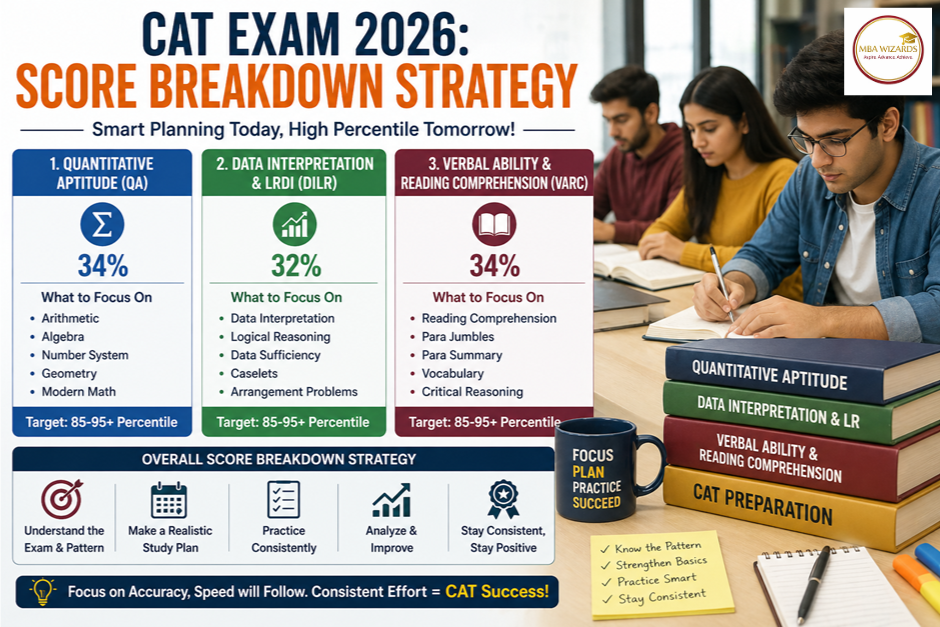
CAT 2026 is not just about how many questions you solve, but how strategically you approach the paper.
Many students think a high score comes from attempting everything, but in reality, success in CAT 2026 score breakdown strategy depends on accuracy, smart question selection, and maintaining balance across all three sections—VARC, DILR, and QA.
The scoring system may seem confusing at first, with raw scores, scaled scores, and percentiles, but once you understand it, you realize that even a few correct answers with high accuracy can significantly boost your percentile.
Instead of chasing maximum attempts, focusing on consistency and clarity of concepts is what truly helps candidates stand out in such a competitive exam.
When students hear “CAT 2026 score breakdown strategy they usually think it’s just marks.
But in reality, CAT has 3 layers:
- Raw Score → Actual marks you get in exam
- Scaled Score → Adjusted score (because paper difficulty differs across slots)
- Percentile → Your rank compared to other students
If your percentile is 95, it means you scored better than 95% of candidates.
CAT has 3 main sections:
1. VARC (Verbal Ability & Reading Comprehension)
- Reading-heavy section
- Focus on understanding, not mugging
- Human Insight:
Students who read daily (articles, editorials) perform better here.
- DILR (Data Interpretation & Logical Reasoning)
- Most unpredictable section
- Puzzle-based questions
This is where many toppers gain advantage—smart selection of sets matters more than solving all. 3. QA (Quantitative Aptitude)
- Maths-based section
- Topics: Arithmetic, Algebra,
Geometry
CAT Score vs Percentile (Approx Idea)
Raw Score
Percentile
150+
99+
120–140
97–99
90–110
90–95
70–85
80–90
50–65
70–80
- Maths-based section
In simple terms, your CAT 2026 score breakdown strategy reflects how well you performed compared to other test-takers across sections like Quantitative Aptitude, Verbal Ability & Reading Comprehension, and Data Interpretation & Logical Reasoning.
But what truly matters isn’t just the raw marks—it’s your percentile. The percentile shows your relative ranking, meaning if you score in the 90th percentile, you’ve performed better than 90% of candidates.
This is why top institutes like the Indian Institutes of Management focus more on percentiles than absolute scores.
A strong CAT score opens doors to top B-schools, but it’s only one part of the selection process, which may also include interviews, academic history, and work experience. Understanding your CAT score helps you set realistic goals and choose the right colleges, making your MBA journey more strategic and achievable.
Yes—but not in a direct “profile-first” way.
The Common Admission Test is primarily a percentile-driven exam, where your performance on test day plays the biggest role.
However, your academic background, work experience, and overall profile start becoming important after the exam,
especially during the selection process of top institutes like the Indian Institutes of Management.
Profile vs Admission Chances in CAT (India)
Profile Factor | Does It Matter in CAT Exam? | Human Insight |
🎯 CAT Percentile | ✅ Very High | This is your entry ticket—without a good percentile, profile won’t matter much |
📚 Academic Record (10/12/Grad) | ❌ Not in Exam | Consistent marks help in shortlisting & final selection |
💼 Work Experience | ❌ Not in Exam | 1–3 years experience is ideal for better weightage |
🧠 Graduation Background | ❌ Not in Exam | Non-engineers may get diversity advantage |
🌍 Gender Diversity | ❌ Not in Exam | Female candidates may get extra points in some colleges |
🗣️ PI (Personal Interview) | ❌ Not in Exam | This is where final selection happens—communication matters most |
✍️ WAT (Written Ability Test) | ❌ Not in Exam | Tests your clarity of thought and writing skills |
https://www.mbawizards.co.in/what-is-cat-exam-2026-syllabus-pattern/
In simple terms, CAT helps you get shortlisted, but your profile helps you convert that shortlist into a final admission.
This is why students with similar percentiles can have very different outcomes—because institutes evaluate candidates holistically beyond just scores.
- CAT Percentile Comes First
Your CAT score is the main filter for shortlisting.
- Profile Matters in Later Stages
Academics, work experience, and diversity are considered during PI/WAT rounds. - Balanced Profile = Better Chances
Consistent academic record + decent CAT score improves conversion chances - Work Experience Adds Value
Relevant experience can give extra weightage in final selection. - Diversity Factor Helps
Non-engineers and female candidates may get additional points in some IIMs.
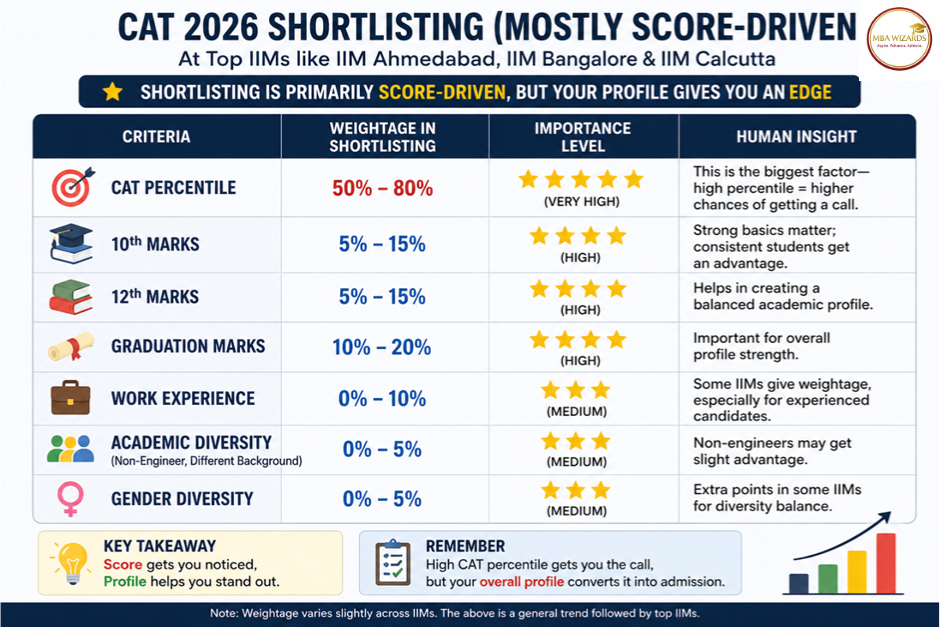
https://www.mbawizards.co.in/what-is-cat-exam-2026-syllabus-pattern/Shortlisting in CAT 2026 (Mostly Score-Driven)
Criteria | Weightage in Shortlisting | Human Insight |
🎯 CAT Percentile | 50% – 80% | This is the biggest factor—high percentile = higher chances of getting a call |
📚 10th Marks | 5% – 15% | Strong basics matter; consistent students get advantage |
📘 12th Marks | 5% – 15% | Helps in creating a balanced academic profile |
🎓 Graduation Marks | 10% – 20% | Important for overall profile strength |
💼 Work Experience | 0% – 10% | Some IIMs give weightage, especially for experienced candidates |
🌍 Academic Diversity | 0% – 5% | Non-engineers may get slight advantage |
⚖️ Gender Diversity | 0% – 5% | Extra points in some IIMs for diversity balance |
- Shortlisting is not 100% profile-based—it’s still heavily dependent on your CAT score.
Common Admission Test score is the biggest factor
The Common Admission Test score is undoubtedly the most important factor when it comes to getting shortlisted for top B-schools in India. However, it’s not the only thing that matters.CAT 2026 SCORE BREAKDOWN STRATEGY Institutes, especially the prestigious Indian Institutes of Management,
also give significant importance to your academic consistency across 10th, 12th, and graduation.
A stable academic record reflects discipline and long-term performance, which is why it carries strong weightage during shortlisting.
Beyond this, some IIMs also assign additional points for factors like work experience, academic diversity (non-engineering background), and gender diversity to create a balanced and diverse classroom. In simple terms,
while your CAT score gets your foot in the door, your overall profile decides how far you go in the admission process.
Profile Factors vs Weightage in IIM Admission
Profile Factor | Typical Weightage | Human Insight |
Academic Consistency | 20% – 40% | A consistent academic record builds strong credibility |
Work Experience | 5% – 10% | 1–3 years experience is often considered ideal |
Academic Diversity | 0% – 5% | Helps non-engineers stand out in a competitive pool |
⚖ Gender Diversity | 0% – 5% | Encourages balanced classroom representation |
Academic consistency (10th, 12th, graduation) is heavily weighted in the selection process of top institutes like the Indian Institutes of Management.
It shows that a student has maintained stable performance over the years, which reflects discipline, focus, and the ability to handle academic pressure.While the Common Admission Test score helps you get shortlisted, your academic record plays a crucial role in strengthening your overall profile during the admission process.
Some IIMs also assign additional points for profile-based factors to ensure a diverse and balanced batch.
https://www.mbawizards.co.in/what-is-cat-exam-2026-syllabus-pattern/At the shortlisting stage of the Common Admission Test, the process is not based on a fully “holistic profile review” like many global universities follow
. Instead, top institutes such as the Indian Institutes of Management use a structured scoring formula.
This means every component—CAT percentile, academic marks (10th, 12th, graduation), and sometimes work experience or diversity factors—is assigned a fixed weightage.
Your overall score is then calculated using this formula to decide whether you get shortlisted. In simple terms
, it’s less about subjective evaluation and more about a clear, numbers-driven system. This approach ensures fairness and transparency,
but it also means that even small differences in marks or percentile can significantly impact your chances.
US Universities: Holistic Admission Process (MBA)
Aspect | US Universities Approach | Human Insight |
🎯 Evaluation Style | Holistic (overall profile review) | Not just scores—your full story matters |
Essays / SOP | Very Important | Your personal story, goals, and clarity can make or break your application |
Test Scores (GMAT/GRE) | Important but not everything | Good scores help, but they don’t guarantee admission |
Academic Record | Important | Consistency matters, but flexibility exists |
Work Experience | Highly Valued | Quality + leadership impact matters more than years |
Letters of Recommendation | Very Important | Third-party validation of your skills and personality |
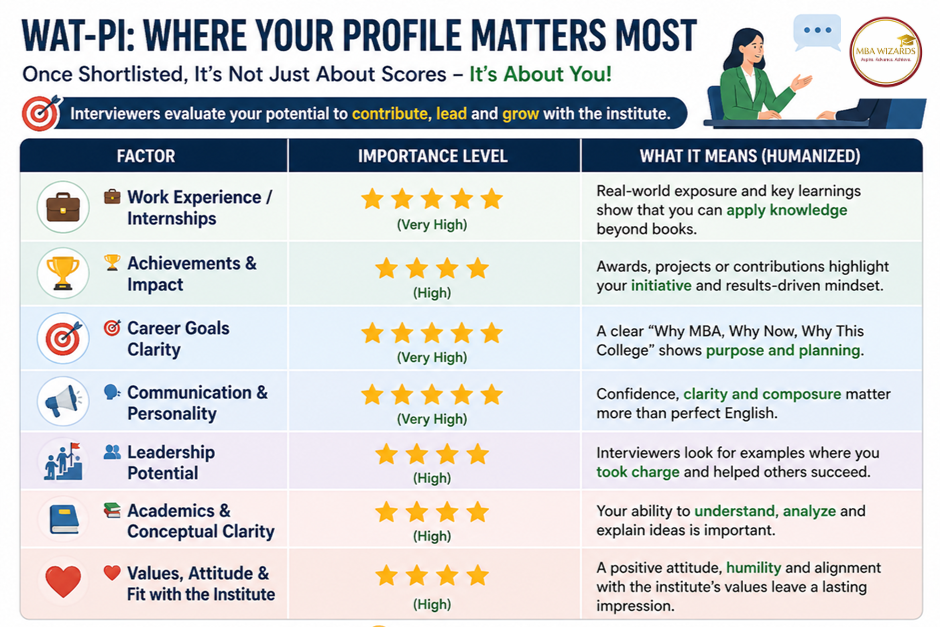
WAT-PI Stage: Where Your Profile Truly Matters
Once you clear the cutoff in the Common Admission Test and get shortlisted by top institutes like the Indian Institutes of Management, the game completely changes.
This is the WAT-PI (Written Ability Test & Personal Interview) stage, where your profile becomes far more important than just your score.
CAT 2026 SCORE BREAKDOWN STRATEGY At this point, everyone already has a good percentile—so what really differentiates candidates is their personality, clarity of thought, and real-life experiences.
Interviewers are not just checking what you know; they are evaluating who you are, how you think, and what value you can bring to the classroom. Your past experiences, achievements, and communication skills start playing a decisive role in converting your shortlist into a final admission.
.
Important Reality Check: CAT vs Profile in IIM Admissions
When it comes to the Common Admission Test, CAT 2026 score breakdown strategy it’s important to stay realistic about how the system works. Top institutes like the Indian Institutes of Management do not follow a fully narrative-based or essay-driven process like Ivy League universities. Instead, the selection process starts with a data-driven, score-focused approach, where your CAT percentile plays the most critical role.
This means one thing very clearly: you cannot compensate for a low CAT score purely with a strong profile. No matter how good your internships, achievements, or extracurriculars are, without a competitive percentile, getting shortlisted becomes extremely difficult.
- Low CAT Score = Limited Chances
A strong profile alone cannot replace a weak percentile. - Score Gets You the Call
CAT performance is the gateway to top B-schools.
Strong Profile Boosts You Post-Shortlist
Good work experience, achievements, and clarity can help you stand out in WAT-PI.
Quick Reality Table
Scenario | Outcome in IIM Admission | Human Insight |
High CAT + Strong Profile | ⭐⭐⭐⭐⭐ High Chance | Ideal combination for conversion |
High CAT + Weak Profile | ⭐⭐⭐ Medium Chance | Risk in PI/WAT stage |
Low CAT + Strong Profile | ⭐ Low Chance | Shortlisting itself becomes difficult |
Low CAT + Weak Profile | ❌ Very Low Chance | Needs major improvement |
Real Example: How Profile Makes the Difference in WAT-PI
Let’s understand this with a practical scenario from the Common Admission Test , cat 2026 score breakdown strategy selection process. Imagine two candidates who have both cleared the cutoff and received interview calls from top institutes like the Indian Institutes of Management.
At this stage, the difference in CAT percentile becomes less important, and what truly matters is how well you present your profile, experiences, and personality during the WAT-PI round.
Candidate Comparison Table
|
Candidate |
CAT Percentile |
Profile Strength |
WAT-PI Performance |
Final Outcome |
|
|
99.5%ile |
Average |
|
|
|
|
99.2%ile |
Strong (Leadership, Impact) |
|
|
 Candidate A
 Uncertain
 Candidate B
 High Chance of Convert
What This Actually Means
Small percentile gap doesn’t guarantee success
The difference between 99.5 and 99.2 is minimal at this stage.
- Profile becomes the game-changer
Leadership, achievements, and real impact give Candidate B an edge.
nterview performance matters more now
Confidence, clarity, and storytelling can outweigh a slightly higher score.
Why Candidate B Can Outperform
- Has real examples to talk about
(projects, leadership, impact)
- Shows clarity of goals and purpose
- Demonstrates
confidence and communication skills
- Leaves a
strong personal impression on the panel
Exact Weightages of Each IIM: Why Strategy Matters
When it comes to admissions through the Common Admission Test, CAT 2026 score breakdown strategy one important thing many students overlook is that every IIM has its own unique selection formula
. Institutes like Indian Institute of Management Ahmedabad, Indian Institute of Management Bangalore, Indian Institute of Management Calcutta,
Indian Institute of Management Lucknow, Indian Institute of Management Kozhikode, and Indian Institute of Management Indore all follow different weightages for CAT score, academics, work experience, and diversity factors.
General Comparison (Not Exact, But Strategic View)
|
IIM |
CAT Weightage |
Academics Focus |
Work Ex Weightage |
Diversity Focus |
Strategy Insight |
|
IIM A |
High |
Medium |
Low–Medium |
Medium |
Score matters most, but profile helps |
|
IIM B |
Medium |
High |
High |
Medium |
Work ex + academics very important |
|
IIM C |
Very High |
Low–Medium |
Low |
Low |
CAT score dominant |
|
IIM L |
High |
Medium |
Medium |
Medium |
Balanced approach |
|
IIM K |
Medium |
Medium |
Medium |
High |
Diversity advantage |
|
IIM I |
Medium |
Very High |
Low |
Medium |
Strong academics required |
Detailed IIM Weightage Comparison (CAT 2026 Strategy)
IIM | CAT Score | Academics (10/12/Grad) | Work Ex | Diversity | WAT-PI | Strategy Insight | |
Ahmedabad | 65–70% | 20–25% | Low | Medium | High | CAT is king, but consistent academics matter | |
Bangalore | 40–50% | 30–40% | High | Medium | High | Work ex + academics heavy → profile-driven | |
Calcutta | 70–75% | 15–20% | Low | Low | Medium | Pure CAT-focused → toppers’ favorite | |
Lucknow | 60% | 20–25% | Medium | Medium | High | Balanced → score + profile both needed | |
Kozhikode | 35–45% | 25–30% | Medium | High | High | Diversity advantage strong | |
Indore | 20–30% | 40–50% | Low | Medium | High | Academics-heavy → past scores critical |
This means your chances of selection are not just about how high you score, but also about how well your profile aligns with a particular institute’s criteria.
For example, some IIMs are highly CAT-focused, while others give significant importance to academic consistency or work experience.
So instead of following a one-size-fits-all approach, candidates should adopt a smart, profile-based strategy—targeting those IIMs where their strengths (whether it’s high percentile, strong academics, or work experience) are most valued.
Smart Strategy Based on Profile
|
Your Profile
Type |
Best IIM
Targets |
|
High CAT, Avg Academics |
IIM C, IIM A |
|
Strong Academics |
IIM I, IIM B |
|
Work Experience (2–4 yrs) |
IIM B, IIM L |
|
Non-Engineer / Female |
IIM K, IIM L |
|
Balanced Profile |
Almost all top IIMs |
The Common Admission Test, (CAT 2026 score breakdown strategy) one of the smartest things you can do is understand that not all IIMs follow the same selection strategy.
Top institutes like Indian Institute of Management Ahmedabad, Indian Institute of Management Bangalore,
and Indian Institute of Management Calcutta each have different weightages for CAT score, academics, work experience, and diversity factors.
Best Books for CAT Exam 2026
Section | Book | Why It’s Useful | Level |
Quantitative Aptitude | Quantitative Aptitude for CAT 2026 by Arun Sharma | Most recommended book; covers basics to advanced with practice sets | Beginner → Advanced |
Quantitative Aptitude | Quantitative Aptitude for CAT by Nishit Sinha | Strong conceptual clarity + exam-level questions | Intermediate → Advanced |
🧠 DILR | Arun Sharma CAT Preparation Set (DILR included) | Best for logical reasoning + caselet practice | All Levels |
VARC | Verbal Ability & Reading Comprehension for CAT | Improves reading skills + RC strategies | Beginner → Advanced |
Vocabulary | Word Power Made Easy | Builds strong vocabulary for VARC section | Beginner |
Practice (PYQs) | PW CAT 28 Years Chapterwise PYQ Book | Previous year questions = real exam pattern understanding | All Levels |
Mock + Practice | Oswaal CAT 25 Years Solved Papers | Helps in time management + accuracy |
When students see consistent, practical guidance—whether it’s about score strategy, mock analysis, or cracking WAT-PI—they are more likely to follow, save, and share your content. Over time, this not only grows your page but also positions MbaWizard as a reliable source for CAT 2026 preparation.
What is a good CAT score for 2026?
A “good” score depends on your target college, but generally a 90+ percentile is considered decent, while 95–99+ percentile is required for top institutes like the Indian Institutes of Management.
What is the difference between CAT score and percentile?
Your CAT score is your raw marks, while the percentile shows how you performed compared to others in the Common Admission Test. Percentile matters more for admissions.
How many questions should I attempt in CAT 2026?
There’s no fixed number, but ideally:
- Attempt 45–55 questions
- Maintain 80–90% accuracy
This balance helps you reach a high percentile.
Is CAT more about accuracy or attempts?
CAT is more about accuracy. Attempting too many questions with low accuracy can reduce your score due to negative marking.
What is the sectional cutoff in CAT?
Top colleges require minimum performance in each section (VARC, DILR, QA). Even with a high overall score, you must clear sectional cutoffs to get shortlisted.
Which section is the toughest in CAT?
For most students, DILR (Data Interpretation & Logical Reasoning) is considered the toughest because it’s unpredictable and requires strong problem-solving skills.
Can I crack CAT 2026 in one year?
Yes, with a consistent study plan, mock tests, and proper strategy, cracking CAT in one year is achievable—even for beginners.
Accelerate Your Score with MBA Wizards AI Diagnostic Tools
Proprietary adaptive test algorithms, speech cadence analytics, and behavioral simulation trained on 25+ years of IIM and 700+ GMAT mentorship data.
AI CAT Mock Interviewer
Adaptive IIM PI simulation with real-time video evaluation, speech cadence analytics, and faculty question banks.
Launch CAT Interviewer ↗AI GMAT Interviewer
Simulate high-stakes behavioral & leadership interviews for ISB, IIM PGPX, and global M7 business schools with instant scoring.
Try GMAT Interviewer ↗GMAT Adaptive Mock Tests
Authentic item-response theory algorithms, 3-question edit feature, and deep sectional error logs for 705+ targeting.
Take Adaptive Mock ↗1-on-1 Faculty Mentorship
Personalized diagnostic strategy consultation with Surinder Gupta to audit your test baseline and target intake roadmap.
Aiming for 705+ on GMAT or 99th %ile in CAT?
Schedule a personalized 1-on-1 strategy call with Surinder Gupta (IIT Roorkee Alum) and get a diagnostic roadmap tailored to your target intake.