CAT Exam 2026 Pattern & Syllabus Complete Guide
CAT EXAM 2026 PATTERN & SYLLABUS AND COMPLETE GUIDE

The CAT EXAM 2026 (Common Admission Test) is the gateway to top MBA colleges like the Indian Institutes of Management.
What makes this exam challenging is not just the syllabus, but the way questions are designed to test your logic, speed, and decision-making ability.
Unlike traditional exams, CAT Exam 2026 pattern and syllabus is more about smart thinking and time management than rote learning. Let’s break it down in a simple way.
The CAT exam 2026 pattern and syllabus are designed to evaluate a candidate’s overall analytical and problem-solving skills rather than just academic knowledge. The exam is divided into three main sections: Verbal Ability & Reading Comprehension (VARC), Data Interpretation & Logical Reasoning (DILR), and Quantitative Ability (QA). Each section tests a different skill set, making it important for students to prepare in a balanced way instead of focusing on only one area. The CAT exam 2026 syllabus mainly includes topics like reading comprehension, para jumbles, puzzles, number systems, arithmetic, algebra, and data interpretation sets.

https://www.mbawizards.co.in/what-is-cat-exam-2026-syllabus-pattern/
What makes CAT different from other MBA entrance exams is its adaptive difficulty level and unpredictable question pattern, which changes every year.
This is why students must focus on concept clarity, regular mock tests, and smart exam strategy rather than memorizing formulas. With the right preparation approach, even average students can score high percentiles.
Understanding the CAT exam 2026 pattern, syllabus, and preparation strategy early gives aspirants a clear roadmap to improve accuracy, speed, and confidence before the final exam.
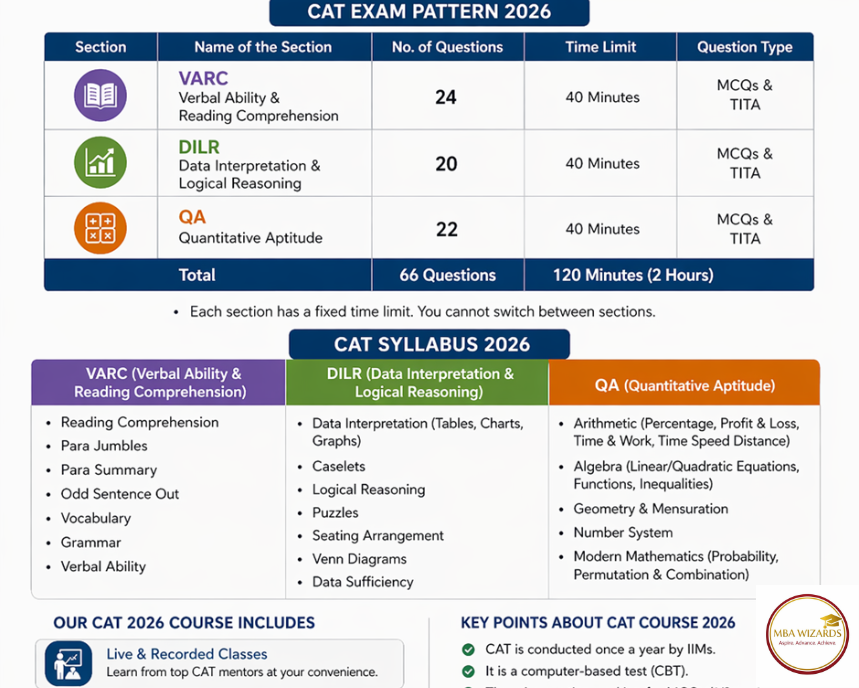
Section | Name | Questions (Approx.) | Time Limit |
VARC | Verbal Ability & Reading Comprehension | 24 | 40 mins |
DILR | Data Interpretation & Logical Reasoning | 20 | 40 mins |
QA | Quantitative Aptitude | 22 | 40 mins |
Total | — | 66 Questions | 120 mins |
CAT Syllabus 2026 (Section-wise)
1. VARC (Verbal Ability & Reading Comprehension)
This section checks your understanding of English.
Key topics:
- Reading Comprehension (highest weightage)
- Para Jumbles
- Para Summary
- Odd Sentence Out
- Basic Grammar & Vocabulary.
DILR (Data Interpretation & Logical Reasoning)
This is the most unpredictable section.
Key topics:
- Caselets
& Data Tables - Bar
Graphs, Pie Charts - Seating
Arrangement - Puzzles
& Logical Sets - Venn
Diagrams
Quantitative Aptitude (QA) Focuses on math concepts and application.
- Arithmetic
(Percentages, Profit & Loss, Time & Work) - Algebra
(Equations, Functions) - Geometry
& Mensuration - Number
System - Modern
Math (Probability, P&C)
·
Preparing for CAT is not about studying everything, but about studying the right way.· Many students start with fear because of the vast syllabus, but the reality is that
CAT repeats patterns and tests clarity more than complexity. With consistent
practice,· mock tests, and a focused strategy,
· even anaverage student can aim for a high percentile. The key is to build strong
basics, analyze mistakes, and improve daily.· Overtime, you’ll realize that CAT is less about intelligence and more about discipline,
patience, and smart workKey - Caselets
Section | Subject Area |
VARC | Verbal Ability & Reading Comprehension |
DILR | Data Interpretation & Logical Reasoning |
QA | Quantitative Aptitude |
Students should also focus on creating a balanced study routine that includes concept learning, daily practice, and regular revision.
Instead of studying randomly, following a structured plan based on the CAT exam 2026 syllabus and pattern helps in better retention and performance. Over time, this disciplined approach improves logical thinking, problem-solving ability, and overall exam readiness.
Lastly, mock tests play a crucial role in final preparation. Attempting full-length mocks under real exam conditions helps students understand their performance level and reduce exam anxiety. By analyzing mistakes after every mock test, aspirants can gradually improve their weak sections and strengthen their overall strategy for the CAT 2026 exam.
Another important factor in CAT preparation is developing strong time management and decision-making skills. In the actual exam, every minute matters, and choosing the right questions becomes more important than attempting all questions.
Many toppers suggest that focusing on high accuracy attempts in CAT 2026 is better than attempting more questions with low accuracy. This strategy not only improves percentile but also builds confidence during the exam.
One of the most unique aspects of the CAT exam 2026 preparation strategy is that it does not reward hard work alone—it rewards smart preparation. Unlike many traditional exams, CAT focuses on how effectively a student can think under pressure.
This is why many aspirants who follow a structured CAT 2026 syllabus-based study plan often perform better than those who study randomly without direction.
The exam tests real-life decision-making skills, which are also important in management careers.
Best Books for CAT Exam 2026 Preparation
A lesser-known fact about the CAT exam 2026 pattern and difficulty level is that the paper is designed to filter candidates based on accuracy and clarity of thought, not just speed. Even a small improvement in question selection strategy can significantly boost percentile. This makes it essential for students to focus on concept-driven preparation instead of memorization, especially in Quantitative Ability and Logical Reasoning sections.
In today’s competitive environment, understanding the CAT exam 2026 strategy, pattern, and syllabus deeply gives aspirants a clear edge. Students who combine consistent practice with smart revision techniques are more likely to achieve 90+ or 99+ percentile.
Section | Book Name | Author | Why to Use |
Quantitative Aptitude | How to Prepare for Quantitative Aptitude for CAT | Arun Sharma | Best for concepts + level-wise practice |
Quantitative Aptitude | Quantum CAT | Sarvesh K Verma | Advanced practice + shortcut techniques |
VARC | Verbal Ability & Reading Comprehension for CAT | Arun Sharma & Meenakshi Upadhyay | Strong RC + verbal practice |
DILR | Logical Reasoning & Data Interpretation for CAT | Arun Sharma | Best for puzzles & data sets |
All Sections | Previous Year CAT Papers | — | Understand real exam pattern |
Basics | NCERT Maths (Class 9–10) | NCERT | Build strong fundamentals |
When it comes to preparing for the CAT exam, understanding the pattern and choosing the right books go hand in hand.
The exam follows a fixed structure with three sections—VARC, DILR, and QA—so your preparation should also be balanced across all three.
Instead of jumping between too many resources, it’s smarter to stick to a few trusted books like How to Prepare for Quantitative Aptitude for CAT by Arun Sharma, Quantum CAT by Sarvesh K Verma, and logical reasoning or verbal books by experts like Nishit Sinha.
These books are designed according to the CAT pattern, starting from basic concepts and gradually moving to advanced-level questions.
The key is not just reading them, but practicing regularly and revising weak areas.
Along with books, mock tests play a huge role because they help you understand timing, pressure, and question selection. In simple terms,
if you follow the pattern, stick to the right books, and practice consistently, you’ll already be ahead of most aspirants
CAT Toppers List (Recent Years + University)
Year | Topper Name | Percentile | Background / University |
2025 | Govind Balasubrahmanian | 100% | Engineering (Bangalore-based student) |
2025 | Vinayak Aggarwal | 99.99% | Engineering background |
2025 | Prashansa Shah | 99.98% | — |
2024 | Apoorva Rajadhyaksha | 100% | IIT Bombay (Electrical Engineering) → MBA at IIM Ahmedabad |
2023 | Multiple candidates | 100% | Mixed (Engineering + Non-engineering) |
2022 | Multiple candidates | 100% | Mostly Engineering + some Non-engineering |
2021 | Multiple candidates | 100% | Diverse academic backgrounds |
CAT 2025 Top Score Highlights
Percentile | No. of Students | Background Trend |
100% | 12 students | Mostly non-engineers (9/12) |
99.99% | 26 students | Mix of engineers & non-engineers |
99.98% | 26 students | High diversity |
While many toppers come from top colleges like IIT Bombay, a large number of high scorers are also from regular universities.
In fact, recent trends show that non-engineering students are increasingly making it to the top percentiles.
This proves that CAT is not about your college, but about your preparation strategy, consistency, and problem-solving ability.
Whether you are from a top university or an average college, with the right approach and practice, you can still compete with the best.
Key Insights:
- Every
year only 10–15
students score 100 percentile
- Most
toppers come from top
universities like IITs, DU, NITs
- But many
toppers are also from normal
colleges (self-study success)
- CAT is
becoming more diverse
(not only engineers anymore)
More Insights About the CAT Exam
The CAT (Common Admission Test) is conducted every year for admission into premier B-
schools like the Indian Institutes of Management and other top institutes. With over 2–3
lakh applicants annually, it remains one of the most competitive exams in India.
The exam is conducted in computer-based mode across multiple slots
Difficulty level varies each year, but DILR is often the most unpredictable section
A 99+ percentile is generally required for top IIMs like Ahmedabad, Bangalore, and Calcutta
CAT scores are also accepted by institutes like Faculty of Management Studies, SP Jain
Institute of Management and Research, and Management Development Institute
CAT Exam – Unique Features Table
Feature | Explanation |
Percentile-Based System | CAT is not about marks, it’s about how you perform compared to others. Even small differences can impact your percentile. |
No Fixed Syllabus | There is no officially defined syllabus, preparation is based on patterns and trends. |
Sectional Time Limit | Each section has a fixed time, and you cannot switch between sections. |
Decision-Making Focus | Success depends on choosing the right questions, not attempting all. |
Unpredictable DILR | Logical reasoning sets change every year, so pattern memorization doesn’t work. |
TITA Questions | Some questions require typing answers and have no negative marking. |
Reading-Based Exam | A large part of the exam focuses on comprehension and understanding passages. |
High Competition | Only about 1–2% of students make it to top institutes like the Indian Institutes of Management. |
Score Normalization | Scores are adjusted across multiple exam slots to ensure fairness. |
Multi-Stage Selection | Clearing CAT is not enough; GD, PI, and WAT rounds are also required. |
Top MBA Colleges Through CAT (India)
| 🏫 Institute | 📍 Location | ⭐ Category | 💼 Known For | 🎯 Avg CAT Cutoff |
|---|---|---|---|---|
| Indian Institute of Management Ahmedabad | Ahmedabad | Tier 1 | Consulting, Finance | 99–100 %ile |
| Indian Institute of Management Bangalore | Bangalore | Tier 1 | Consulting, Product roles | 99–100 %ile |
| Indian Institute of Management Calcutta | Kolkata | Tier 1 | Finance, Trading | 99+ %ile |
| Indian Institute of Management Lucknow | Lucknow | Tier 1 | General Management | 97–99 %ile |
| Indian Institute of Management Indore | Indore | Tier 1 | Marketing, HR | 97–99 %ile |
| Indian Institute of Management Kozhikode | Kozhikode | Tier 1 | Analytics, Finance | 97–99 %ile |
Best Universities Abroad for MBA (After CAT Prep)
University | Country | Key Strength |
Harvard Business School | USA | Leadership & global network |
Stanford Graduate School of Business | USA | Entrepreneurship & startups |
London Business School | UK | Global exposure & finance |
INSEAD | France/Singapore | 1-year MBA, diverse students |
MIT Sloan School of Management | USA | Tech + analytics focus |
University of Oxford Saïd Business School | UK | Strong global brand |
University of Cambridge Judge Business School | UK | Innovation & research |
While top global universities don’t directly accept CAT scores, the preparation you do for CAT builds the exact skills you need for exams like GMAT or GRE. Universities like Harvard, Stanford, or INSEAD offer much more than just a degree—they give you global exposure, diverse learning, and career opportunities across the world.
Of course, the investment is higher, but the experience and growth you get can completely transform your career.
If your goal is to build an international career and explore global opportunities, then going abroad after CAT preparation can be a powerful next step.
Accelerate Your Score with MBA Wizards AI Diagnostic Tools
Proprietary adaptive test algorithms, speech cadence analytics, and behavioral simulation trained on 25+ years of IIM and 700+ GMAT mentorship data.
AI CAT Mock Interviewer
Adaptive IIM PI simulation with real-time video evaluation, speech cadence analytics, and faculty question banks.
Launch CAT Interviewer ↗AI GMAT Interviewer
Simulate high-stakes behavioral & leadership interviews for ISB, IIM PGPX, and global M7 business schools with instant scoring.
Try GMAT Interviewer ↗GMAT Adaptive Mock Tests
Authentic item-response theory algorithms, 3-question edit feature, and deep sectional error logs for 705+ targeting.
Take Adaptive Mock ↗1-on-1 Faculty Mentorship
Personalized diagnostic strategy consultation with Surinder Gupta to audit your test baseline and target intake roadmap.
Aiming for 705+ on GMAT or 99th %ile in CAT?
Schedule a personalized 1-on-1 strategy call with Surinder Gupta (IIT Roorkee Alum) and get a diagnostic roadmap tailored to your target intake.