
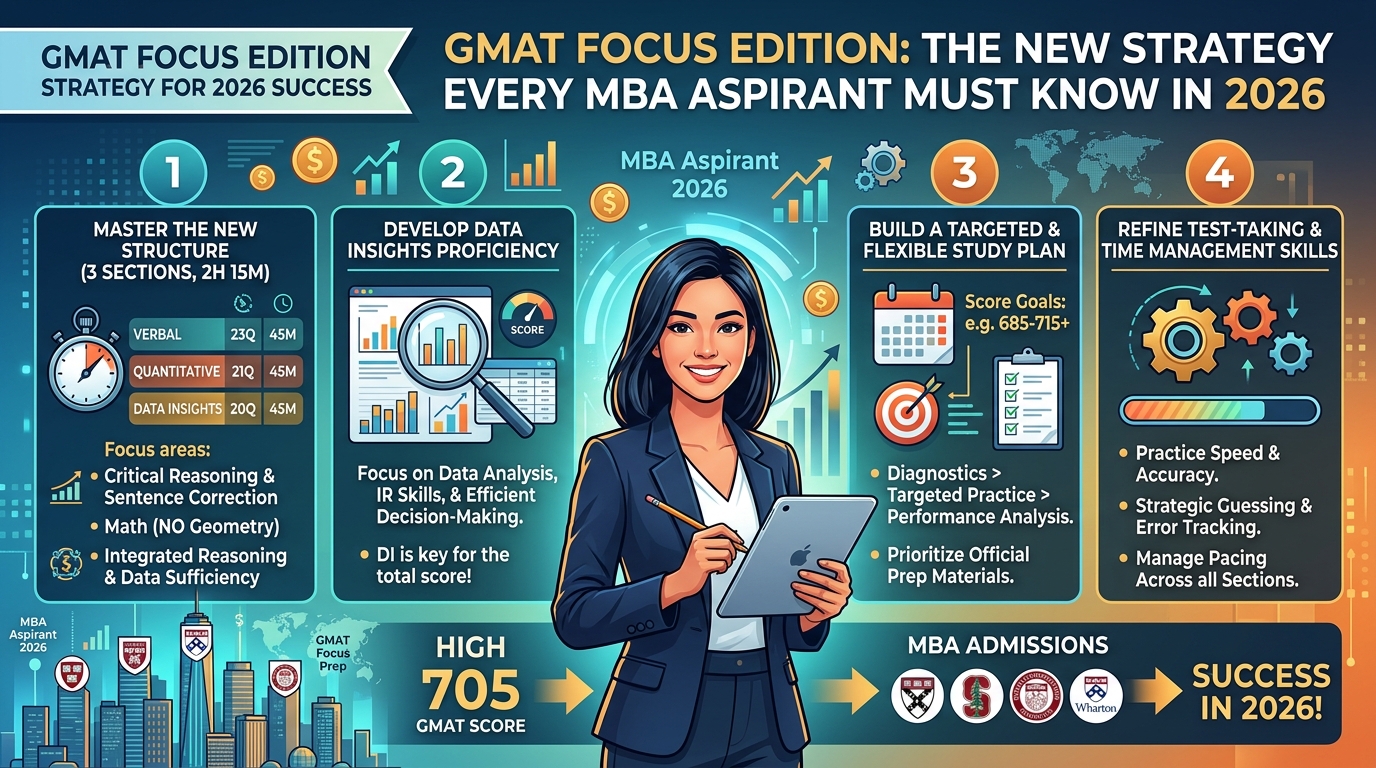
The MBA admissions landscape is evolving rapidly, and one of the biggest changes in recent years is the introduction of the GMAT Focus Edition by the Graduate Management Admission Council.
This updated version of the GMAT has become one of the most trending topics among MBA aspirants in 2026, especially for students targeting top business schools in the USA, UK, Canada, and Europe.
If you are planning to apply for an MBA, understanding the GMAT Focus Edition format, scoring system, and preparation strategy can significantly improve your chances of admission.
In this guide, we will break down everything you need to know.
What Is the GMAT Focus Edition?
The GMAT Focus Edition is the redesigned version of the traditional GMAT exam. It was introduced to make the test more relevant to modern business education and analytical skills.
The exam focuses on data-driven decision making, analytical reasoning, and problem solving, which are essential skills for future business leaders.
Key Highlights of GMAT Focus Edition
- Shorter exam duration (around 2 hours 15 minutes)
- More focus on data analysis and reasoning
- No Analytical Writing Assessment (AWA)
- No Sentence Correction section
- Flexible question review and editing options
- New scoring scale from 205 to 805
These changes make the exam more efficient and aligned with MBA program expectations.
GMAT Focus Edition Exam Structure
The GMAT Focus Edition consists of three main sections.
1. Quantitative Reasoning
This section tests your ability to analyze data and solve mathematical problems.
Topics include:
- Algebra
- Arithmetic
- Word problems
- Data interpretation
Unlike the previous GMAT version, geometry questions have been removed, allowing the test to focus on practical quantitative skills.
2. Verbal Reasoning
This section evaluates your ability to understand and analyze written information.
Key areas include:
- Reading comprehension
- Critical reasoning
- Logical analysis
The sentence correction section has been removed, which many students find beneficial because the focus is now more on logic and interpretation rather than grammar rules.
3. Data Insights
One of the biggest changes in the GMAT Focus Edition is the Data Insights section.
This section combines elements of previous Integrated Reasoning and data interpretation questions.
Students must analyze:
- Charts
- Tables
- Multi-source reasoning
- Graph interpretation
Business schools value this section because it reflects real-world decision-making skills used in business environments.
Why the GMAT Focus Edition Is Trending in 2026
The GMAT Focus Edition has become one of the most discussed MBA entrance exams globally for several reasons.
1. Shorter and More Efficient Exam
The new format is significantly shorter than the old GMAT, making it less mentally exhausting for candidates.
2. More Relevant for Business Careers
The focus on data interpretation and analytics aligns with modern MBA curricula that emphasize data-driven leadership.
3. Greater Score Flexibility
Students can now review and change answers within a section, which reduces exam pressure and improves performance.
4. Widely Accepted by Top MBA Programs
Most top business schools now accept GMAT Focus Edition scores, making it a safe and strategic option for MBA applicants.
GMAT Focus Edition Preparation Strategy
Preparing for the GMAT requires a smart strategy, not just hard work.
Here are the most effective preparation tips.
1. Understand the New Exam Pattern
Before starting preparation, become familiar with:
- Section timing
- Question types
- Scoring system
Understanding the structure helps you optimize your preparation plan.
2. Focus on Data Interpretation Skills
Since the exam emphasizes data analysis, practice questions involving:
- Charts
- Graphs
- Business case data
- Logical data interpretation
These skills are crucial for achieving a high GMAT score.
3. Practice Time Management
Even though the exam is shorter, time pressure remains high.
Practice full-length mock tests to improve:
- Speed
- Accuracy
- Decision-making
4. Strengthen Critical Reasoning
Critical reasoning questions require analytical thinking and logical deduction.
Develop habits such as:
- Identifying assumptions
- Evaluating arguments
- Recognizing logical patterns
5. Take Full-Length Mock Tests
Mock exams simulate real test conditions and help you:
- Identify weak areas
- Improve pacing
- Build exam confidence
Most successful candidates take 10–15 mock tests before the actual exam.
What Is a Good GMAT Focus Edition Score?
The scoring range for the GMAT Focus Edition is 205–805.
Here is a rough benchmark for competitive MBA programs:
| Score Range | Competitiveness |
|---|---|
| 705+ | Top global MBA programs |
| 655–705 | Strong competitive score |
| 605–655 | Average MBA admissions |
| Below 605 | Needs improvement |
However, MBA admissions also consider work experience, leadership potential, essays, and interviews.
Final Thoughts
The GMAT Focus Edition represents the future of MBA admissions testing.
With its shorter format, modern question types, and focus on analytical decision-making, the exam better reflects the skills required in today’s business world.
For MBA aspirants in 2026 and beyond, preparing strategically for the GMAT Focus Edition can significantly strengthen their applications to top global business schools.
The key to success is early preparation, consistent practice, and a clear understanding of the exam structure.