
CAT Exam Preparation ,Syllabus and Guide
CAT Exam preparation syllabus and guide

Student want clear guidance on what to do next. This is where you should focus on adding sections like a structured preparation roadmap, mock test strategy, best books, and CAT Exam Preparation ,Syllabus and Guide a complete understanding of the selection process.
By doing this, your blog shifts from being just informative to becoming a practical guide that actually helps students prepare and make decisions. The goal is simple: help readers move from confusion to clarity, and CAT Exam Preparation ,Syllabus and Guide from planning to execution, which also improves your SEO performance and user engagement.
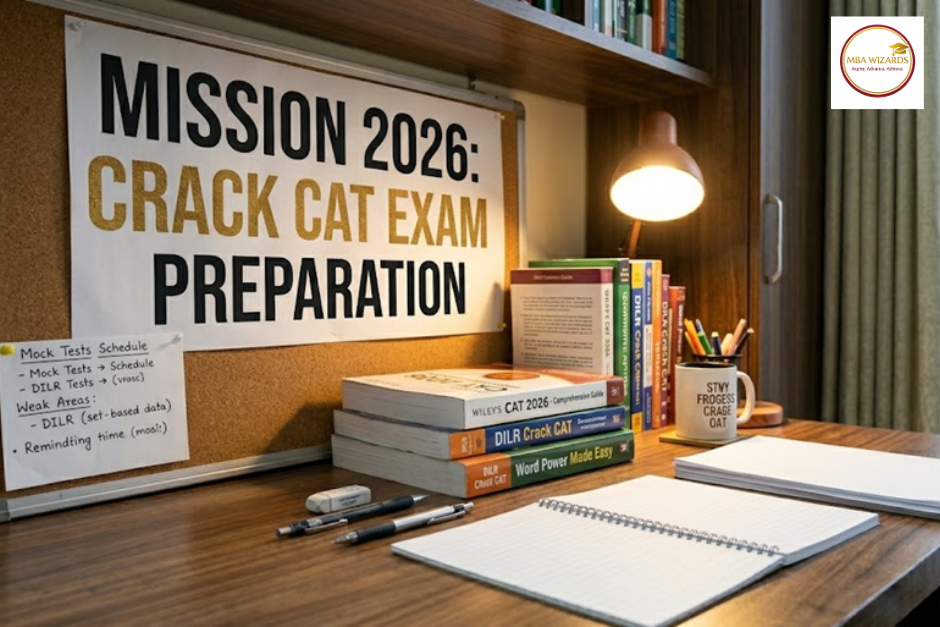
Focus on Concepts First
Strong basics in QA, VARC, and DILR are non-negotiable.THE CAT Exam Preparation ,Syllabus and Guide points below:
Practice Daily, Not Occasionally
Consistency beats last-minute effort.
Time Management is Key
Learn when to skip and when to attempt.
Mock Tests are Game-Changers
Give 1–2 mocks per week and increase frequency later.
Analyze Every Mock
Improvement comes from analysis, not just attempts.Limit Resources..Stick to a few good books instead of switching constantly. Sectional Balance Matters
Don’t ignore weak sections—cutoffs are real.
Topper vs Average Student (Real Difference)
Factor | 🏆 Topper Mindset | 😐 Average Student |
📚 Study Approach | Focus on concepts + clarity | Focus on quantity & random practice |
⏱️ Time Management | Plans and follows schedule | Studies without clear plan |
📊 Mock Tests | Gives + analyzes deeply | Gives mocks but skips analysis |
🧠 Question Selection | Attempts smartly | Tries to attempt everything |
🔄 Consistency | Daily disciplined effort | Irregular preparation |
❌ Mistake Handling | Learns and improves | Repeats same mistakes |
🎯 Goal Clarity | Clear target percentile | Vague or unrealistic goals |
https://www.mbawizards.co.in/cat-exam-2026-pattern-syllabus-guide/The Common Admission Test CAT Exam Preparation ,Syllabus and Guide requires more than just hard work—it needs clarity, consistency, and the right strategy. Instead of jumping between resources, a structured approach helps you stay focused and improve steadily over time.
Start by building strong basics in all three sections—VARC, DILR, and QA. Once your concepts are clear, move to regular practice and gradually introduce mock tests.
The CAT Exam Preparation ,Syllabus and Guide key is not just solving questions, but understanding why you got them right or wrong. Over time, your focus should shift from learning concepts to improving speed, accuracy, and decision-making under pressure.
Section | Book | How to Use It | Strategy Level | Human Insight |
QA | How to Prepare for Quantitative Aptitude for CAT | Start with basics → solve LOD 1 → move to LOD 2 & 3 | Beginner → Advanced | Don’t rush to higher levels without clarity |
QA | Quantitative Aptitude for CAT | Focus on concept clarity + selected practice | Intermediate | Best for strengthening weak topics |
DILR | How to Prepare for Data Interpretation for CAT | Practice 2–3 sets daily + focus on logic building | All Levels | Selection of sets matters more than solving all |
DILR | Logical Reasoning and Data Interpretation for CAT | Solve mixed difficulty sets + timed practice | Intermediate → Advanced | Improves real exam thinking ability |
VARC | Verbal Ability and Reading Comprehension for CAT | Daily RC practice + VA questions | All Levels | Reading habit is the real game-changer |
Vocabulary | Word Power Made Easy | Learn 1–2 sessions daily + revise regularly | Beginner | Helps in long-term retention of words |
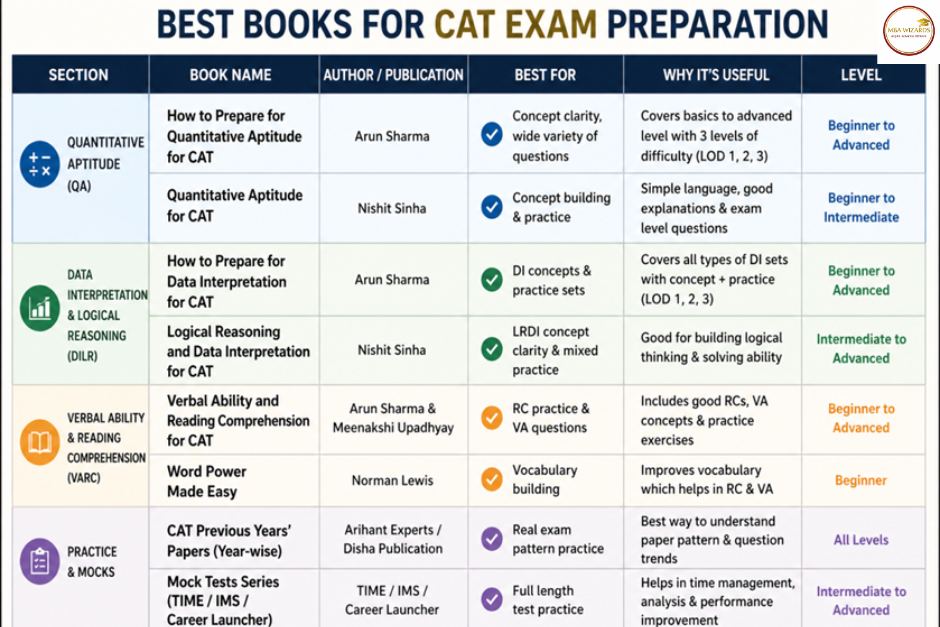
CAT Exam Preparation ,Syllabus and Guide Choosing the right books is a crucial part of preparing for the Common Admission Test, but simply collecting multiple resources won’t guarantee success.
The key is to focus on a limited set of high-quality books and use them strategically. CAT Exam Preparation ,Syllabus and Guide For Quantitative Aptitude and DILR, books by Arun Sharma are widely recommended for building concepts from basic to advanced levels,
while Nishit Sinha is excellent for strengthening understanding and practicing exam-level questions. CAT Exam Preparation ,Syllabus and Guide For VARC, developing a reading habit along with structured practice is essential, and books like Word Power Made Easy by Norman Lewis help improve vocabulary over time. Along with these, solving previous years’ papers and taking mock tests should be a regular part of your routine
. In simple terms, it’s not about how many books you study—it’s about how well you understand and revise the ones you choose.
Why Most Student Profiles Fail (CAT 2026 Reality)
https://www.mbawizards.co.in/cat-exam-2026-pattern-syllabus-guide/The Common Admission Test CAT Exam Preparation ,Syllabus and Guide is less about quantity and more about clarity and consistency. Many students make the mistake of collecting too many resources, which leads to confusion and incomplete preparation. Instead and a CAT Exam Preparation ,Syllabus and Guide , a smart approach is to choose one reliable book per section and use it thoroughly—from basic concepts to advanced practice.
For example, starting with structured guides by Arun Sharma or Nishit Sinha can help build strong fundamentals, but the real improvement comes from revising those same concepts and applying them in mocks and previous year questions.
The goal is not to finish multiple books, but to master a few and understand the exam pattern deeply. In simple terms, the right book selection simplifies your preparation, saves time, and keeps your focus on what actually matters—accuracy and performance.
⏳ Pressure Level | Very low academic pressure | High pressure due to boards |
🎯 Goal Clarity | Mostly unclear career goals | More awareness about future streams |
📖 Study Habit | Developing habits | More disciplined routine |
📝 Exam Strategy | Little to no strategy | Start practicing exam techniques |
💡 Focus Area | Learning & curiosity | Marks & performance |
📊 Competition Awareness | Very low | Moderate to high awareness |
🚀 Advantage | Strong base building time | Strong execution & scoring ability |
⚖️ Challenge | Lack of seriousness sometimes | Stress & time pressure |
In the journey toward the Common Admission Test, CAT Exam Preparation ,Syllabus and Guide many students assume that a “good profile” automatically guarantees success—but that’s not how it works, especially for top institutes like the Indian Institutes of Management.
Most profiles fail not because they are weak, but because they are unclear, inconsistent, or poorly presented.
Students often lack strong academic consistency, have no clear career direction, or cannot justify their past decisions during the interview.Another major issue is generic achievements—everyone has similar internships or certifications,
but very few can demonstrate real impact or learning.CAT Exam Preparation ,Syllabus and Guide In the WAT-PI stage,it’s not just about what you’ve done, but the CAT Exam Preparation ,Syllabus and Guide how well you can explain it with confidence and clarity. This is why even high-percentile candidates sometimes fail to convert calls
Common Mistakes: Class 8 vs Class 10 Students
Most students in Class 8 and Class 10 make different types of mistakes that directly affect their performance.
CAT Exam Preparation ,Syllabus and Guide Class 8, the main problem is lack of seriousness and weak study habits.
Students often study without understanding concepts, avoid regular revision, and get easily distracted by mobile phones or entertainment. Since there is less academic pressure,
they don’t realize the importance of building strong fundamentals early
🔍 Area | 🧑🎓 Class 8 Mistakes | 🧑🎓 Class 10 Mistakes |
📚 Study Approach | Studying without understanding concepts | Rushing syllabus only for marks |
⏳ Time Management | Wasting time on distractions (games/social media) | Poor balance between boards & revision |
🧠 Revision Habit | Rare or no revision at all | Last-minute revision pressure |
📝 Exam Practice | Avoiding tests or mock papers | Not analyzing mistakes in tests |
🎯 Focus | No clear study routine | Overthinking about marks & result |
📖 Notes Making | No proper notes | Overloaded or messy notes |
💡 Concept Clarity | Skipping basics | Ignoring weak topics due to fear |
😰 Stress Handling | Ignoring discipline due to low pressure | High stress and exam anxiety |
📊 Consistency | Starts strong but loses interest | Irregular revision schedule |
🚀 Learning Style | Passive learning (just reading) | Rote learning instead of understanding |
In Class 10, the situation is different. Students face high pressure due to board exams, which often leads to stress and overthinking. Many students focus only on marks instead of understanding concepts.
They also depend heavily on last-minute revision and sometimes ignore analyzing their mock test mistakes, which slows down improvement.
In both cases, the biggest mistake is not lack of intelligence, CAT Exam Preparation ,Syllabus and Guide but lack of strategy, consistency, and smart study planning.
Students who fix these early usually perform much better in higher classes.
CAT Exam Mistakes: Topper vs Average Students
🔍 Area | 🧑🎓 Average Students | 🏆 Topper Students |
📚 Study Approach | Random study, no fixed plan | Structured daily + weekly strategy |
🧠 Concept Clarity | Weak basics, memorization focus | Strong fundamentals and logic-based learning |
📝 Mock Tests | Attempt without analysis | Deep analysis of every mistake |
⏳ Time Management | Spend too long on difficult questions | Smart skipping and prioritization |
📖 Revision | Last-minute revision only | Regular and planned revision |
😰 Exam Pressure | Panic in difficult sections | Calm and adaptive mindset |
🎯 Question Selection | Try to solve everything | Focus only on high-confidence questions |

CAT Exam Insights (What Actually Makes the Difference)
Lorem ipsum dolor sit amet, consectetur adipiscing elit. Ut elit tellus, luctus nec ullamcorp
1. CAT is a “selection exam”, not a syllabus exam
You don’t need to study everything. Success depends on selecting the right questions, not solving all questions.
2. Speed + Accuracy > Hard Work
Many students study 8–10 hours but still don’t score well. Toppers focus on:
- Faster decision making
- High accuracy
- Avoiding negative marking traps
3. Mock tests are more important than study material
CAT Exam Preparation ,Syllabus and Guide Average students treat mocks as practice.
Toppers treat mocks as real exam simulation + improvement tool.
70% improvement comes from mock analysis, not new study material.
4. Strategy changes everything
CAT is not just knowledge-based; it is strategy-based:
- Which section to start with
- Which questions to skip
- How to manage time per section
5. Weak areas cannot be ignored
Average students avoid weak topics.
Toppers do the opposite — they attack weak areas early to reduce fear.
6. Pressure handling is a hidden skill
In CAT, many students know answers but lose marks due to stress.
Top performers stay calm even when:
- Section is tough
- Time is running out
Many CAT 2026 aspirants tend to repeat the same avoidable mistakes that quietly reduce their chances of a high percentile.
One of the biggest issues is starting preparation without understanding the exam pattern and weightage, which leads to wasted effort on low-impact topics.
CAT Exam Preparation ,Syllabus and Guide Another common mistake is relying on too many books and resources instead of mastering a few trusted ones and revising them properly. Students also often ignore mock tests or take them without proper analysis, which prevents them from identifying weak areas.
Time management during preparation and in the actual exam is another major challenge, as many students either spend too much time on difficult questions or rush through easier ones carelessly.
Lastly, lack of consistency—studying in bursts instead of following a steady daily routine—creates gaps in preparation. Avoiding these mistakes can significantly improve accuracy, speed, and overall performance in CAT 2026.
What is the syllabus of the CAT exam?
The Common Admission Test syllabus is divided into three sections:
- VARC (Verbal Ability & Reading Comprehension) – RC passages, para jumbles, summary
- DILR (Data Interpretation & Logical Reasoning) – puzzles, charts, caselets
- QA (Quantitative Aptitude) – arithmetic, algebra, geometry, number system
Is the CAT syllabus fixed every year?
No, CAT does not have an officially fixed syllabus, but the topics remain mostly consistent every year with slight variations in difficulty and question types.
Which section has the highest weightage in CAT?
All three sections have almost equal weightage, so you need balanced preparation to score well overall.
How should beginners start CAT preparation?
Start with:
- Understanding basic concepts (especially QA)
- Daily reading for VARC
- Practicing basic sets for DILR
- Gradually moving to sectional tests and mocks
How many hours should I study daily for CAT?
- 2–3 hours daily for working professionals
- 4–6 hours daily for full-time aspirants
Consistency matters more than long study hours.
Accelerate Your Score with MBA Wizards AI Diagnostic Tools
Proprietary adaptive test algorithms, speech cadence analytics, and behavioral simulation trained on 25+ years of IIM and 700+ GMAT mentorship data.
AI CAT Mock Interviewer
Adaptive IIM PI simulation with real-time video evaluation, speech cadence analytics, and faculty question banks.
Launch CAT Interviewer ↗AI GMAT Interviewer
Simulate high-stakes behavioral & leadership interviews for ISB, IIM PGPX, and global M7 business schools with instant scoring.
Try GMAT Interviewer ↗GMAT Adaptive Mock Tests
Authentic item-response theory algorithms, 3-question edit feature, and deep sectional error logs for 705+ targeting.
Take Adaptive Mock ↗1-on-1 Faculty Mentorship
Personalized diagnostic strategy consultation with Surinder Gupta to audit your test baseline and target intake roadmap.
Aiming for 705+ on GMAT or 99th %ile in CAT?
Schedule a personalized 1-on-1 strategy call with Surinder Gupta (IIT Roorkee Alum) and get a diagnostic roadmap tailored to your target intake.