

CAT Mock test strategy are the most important part of CAT exam 2026 preparation. They are not just practice tests—they simulate the real exam environment and help you understand your actual performance.
Many students study concepts but fail to improve because they don’t analyze mocks properly. In reality, your CAT 2026 percentile depends more on mock performance than just syllabus completion.
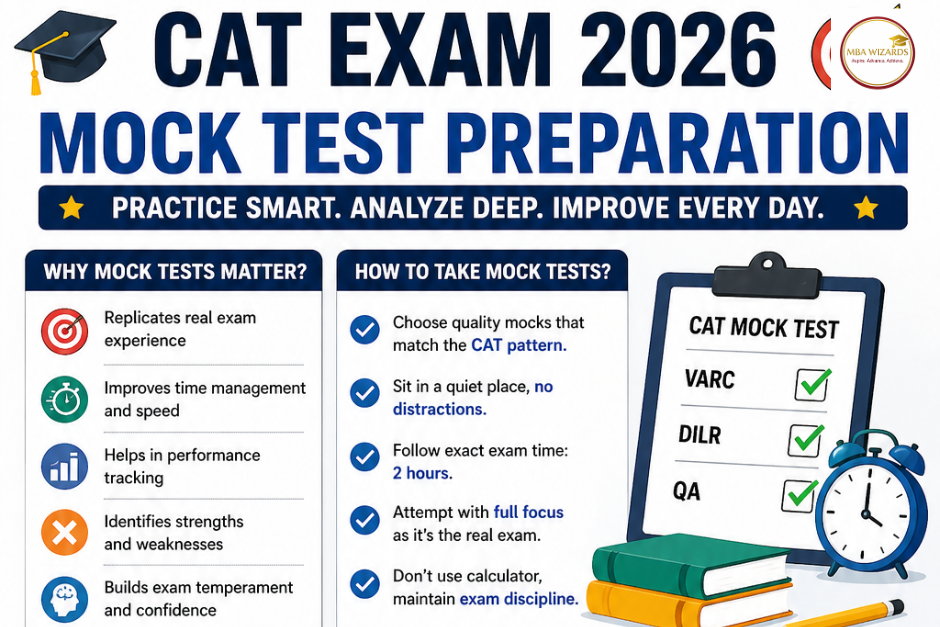
https://www.mbawizards.co.in/cat-exam-2026-pattern-syllabus-guide/CAT Mock test strategy tests are not just about checking your score—they are about learning how to perform under pressure. Many students give 20–30 mocks but don’t improve because they skip analysis. On the other hand, some students give fewer mocks but improve consistently because they deeply understand their mistakes.
The CAT Mock test strategy real benefit of mock tests comes from analysis, not just attempting them. After every mock, you should spend time understanding your mistakes, identifying weak areas, and improving your strategy.
CAT Mock test strategy and This process helps you avoid repeating the same errors and gradually increases your score. In simple terms, mocks are not just tests—they are your practice ground for the final exam, helping you build confidence, reduce exam fear, and move closer to a high percentile in CAT 2026.
Mock Analysis Strategy (Most Important)
Area | What To Analyze |
Accuracy | How many correct vs wrong |
Question Selection | Did you pick the right questions? |
Time Management | Where did you waste time? |
Weak Areas | Which topics need improvement? |
Strong Areas | Where can you score more? |
Common Mock Test Mistakes
Mistake | What To Do Instead |
Giving mocks without analysis | Spend 2–3 hours analyzing |
Attempting all questions | Focus on smart attempts |
Ignoring weak sections | Improve balance |
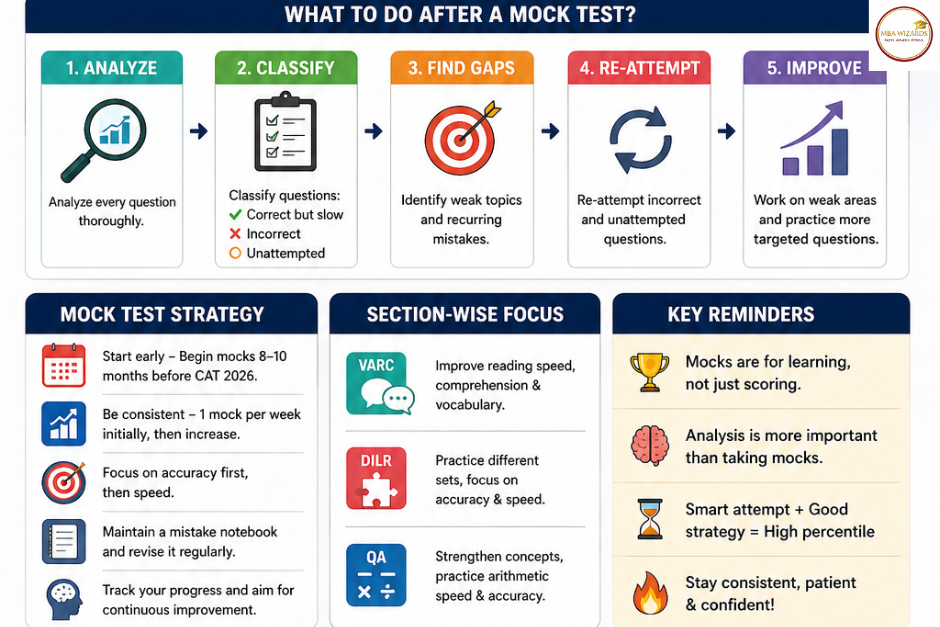
The most powerful part of mock preparation is analysis. After every mock, spend at least 2–3 hours reviewing your performance. Identify patterns:
Where did you waste time?
Which questions should you have skipped?
What types of questions are consistently wrong?
Break your analysis into three categories:
✔ Questions you got right (but took too long)
✔ Questions you got wrong (concept gaps)
✔ Questions you didn’t attempt (fear or time issue)
This structured approach helps you turn every mock into a learning opportunity, not just a score report.
VARC Preparation Strategy Breakdown
Area | What To Do | Why It Matters |
Reading Habit | Read daily (editorials, blogs) | Improves comprehension speed |
RC Practice | Solve 2–3 RCs daily | Builds accuracy |
VA Topics | Practice para jumbles, summary | Scoring area |
Time Management | Limit 8–10 min per RC | Avoid time waste |
Mock Practice | Attempt VARC sectionals | Real exam feel |
- Start Early: Begin mocks at least 8–10 months before CAT 2026
- Frequency Matters: 1 mock/week → then 2–3 mocks/week closer to exam
- Focus on Accuracy First: Speed comes later
- Sectional Strategy: Build a clear attempt plan for VARC, DILR, QA
- Question Selection is King: Not all questions are meant to be solved
- Revise Mistakes Notebook: Track repeated errors
- Analyze Deeply: Spend more time analyzing than attempting
Mock Test Strategy Table
Phase | Timeline | Mock Frequency | Focus Area | What You Should Do |
Phase 1: Foundation | Now – 6 months before CAT | 1 mock / 10–15 days | Concept clarity | Don’t chase score, focus on understanding mistakes |
Phase 2: Build-Up | 6–3 months before CAT | 1 mock / week | Accuracy + Selection | Start building attempt strategy, improve weak areas |
Phase 3: Intensive | 3–1 month before CAT | 2–3 mocks / week | Speed + Strategy | Focus on time management & smart question selection |
Phase 4: Final Lap | Last 30 days | 3–4 mocks / week | Consistency | Simulate real exam, fix small mistakes, stay calm |
CAT Mock test strategy Choosing between Indian and abroad universities isn’t just about prestige—it’s about fit, goals, and the kind of growth you’re aiming for.
CAT Mock test strategy Top Indian institutions like Indian Institutes of Technology, Indian Institutes of Management, and University of Delhi are highly competitive and primarily entrance-exam driven, offering strong academic rigor, structured learning, and excellent return on investment due to lower fees and solid placements.
CAT Mock test strategy On the other hand, global universities such as Harvard University, Massachusetts Institute of Technology, and University of Oxford follow a holistic admission process that values academics along with extracurriculars, essays, and overall personality, providing flexible curricula, research exposure, and international networking opportunities.
https://www.mbawizards.co.in/cat-2025/ While Indian colleges build discipline and strong fundamentals, abroad CAT Mock test strategy universities emphasize innovation, exploration, and global perspective.
Factor | 🇮🇳 Indian Universities (IIT, IIM, DU) | 🌍 Abroad Universities (Ivy League, MIT, Oxford) |
Admission Process | Entrance exams (JEE, CAT) – extremely competitive | Holistic (academics + SOP + extracurriculars + essays) |
Acceptance Rate | Very low (top IITs <1–2%) | Low but relatively higher (3–10%) |
Fees | Affordable (₹2–4 lakh/year approx) | Very expensive ($40k–$70k/year) |
Academic Style | Theory-focused, structured | Flexible, practical, interdisciplinary |
Research Exposure | Limited (improving) | Strong global research + funding |
Global Exposure | Mostly domestic | High international exposure & diversity |
Career Opportunities | Strong in India (placements) | Global job access + networking |
Flexibility | Fixed curriculum | Choose majors, minors, courses freely |
ROI (Return on Investment) | High (low cost + good jobs) | Depends (high cost but global opportunities) |
Campus Life | Competitive, exam-driven | Balanced (academics + extracurriculars) |
https://www.mbawizards.co.in/cat-2025/Ultimately CAT Mock test strategy , the right choice depends on your priorities—budget, career vision, and learning style—because success comes less from the college name and more from how well the environment matches your ambitions.
Another major difference lies in flexibility and personalization. CAT Mock test strategy Indian universities usually follow a fixed curriculum, which is great if you prefer structure and clarity. Abroad universities, however, allow you to choose majors, minors, and even switch fields, giving you the freedom to design your academic journey. CAT Mock test strategy.
This flexibility often leads to more creativity and innovation, but it also requires self-direction and clarity of goals. Financially, the gap is significant—studying abroad can be expensive, but scholarships and long-term global career opportunities can balance that for many students.
At a deeper level, the decision reflects your mindset.CAT Mock test strategy If you thrive in a competitive, exam-driven environment and want a cost-effective path with strong outcomes in India, staying here makes sense.
CAT Mock test strategy But if you’re looking for global exposure, diverse peer groups, and a chance to build something unconventional, studying abroad can open those doors. CAT Mock test strategy In the end, it’s not about which system is “better”—it’s about which one aligns with your strengths, ambitions, and the kind of life you want to build.
❌ Mistake | 🔍 What Students Do | ✅ What You Should Do |
Focus only on score | Check percentile and move on | Analyze deeply, focus on improvement trend |
No proper analysis | Spend 2 hrs on mock, 20 mins on review | Spend 2–3 hrs analyzing every mock |
Over-attempting questions | Try to solve everything | Attempt fewer, high-accuracy questions |
Ignoring weak areas | Practice only strong topics | Target weak topics deliberately |
Not skipping tough questions | Waste time on 1 question | Learn to leave questions early |
Same strategy every time | Repeat same mistakes | Update strategy after every mock |
Comparing with others | Focus on others’ scores | Track your own progress & accuracy |
No mistake tracking | Forget errors after mock | Maintain a mistake notebook/log |
Casual mock attempt | Give mock with distractions | Simulate real exam conditions |
No sectional focus | Ignore weak section (VARC/DILR/QA) | Practice sectional tests regularly |
CAT Exam Preparation ,Syllabus and Guide
Many students focus only on their score, checking the percentile and moving on without extracting any real learning. CAT Mock test strategy They spend hours attempting a mock but barely invest time in analyzing it, which defeats the entire purpose.
CAT Mock test strategy A common pattern is over-attempting questions in the hope of maximizing marks, instead of prioritizing accuracy and smart selection. At the same time, weak areas are often ignored, while strong topics get repeated practice, creating an imbalance in preparation.
Students also tend to waste too much time on difficult questions instead of learning the crucial skill of skipping strategically. CAT Mock test strategy What makes it worse is sticking to the same approach across mocks, even when results aren’t improving, and constantly comparing scores with others, which only affects confidence.
CAT Mock test strategy Without maintaining a mistake log, the same errors keep repeating, and casual mock attempts—full of distractions—fail to simulate real exam pressure.
CAT Mock test strategy On top of that, ignoring sectional preparation leads to uneven performance across VARC, DILR, and QA. The shift needs to be clear: treat every mock as a learning tool, focus on deep analysis, track your own progress, and consistently refine your strategy—because in CAT, improvement comes not from giving more mocks, but from learning better from each one.
common Mistakes in CAT Mock Tests
- Focusing only on score
Ignoring learning, just checking percentile - Skipping detailed analysis
Not reviewing mistakes properly - Over-attempting questions
Trying to solve everything instead of being selective - Ignoring weak areas
Practicing only comfortable topics - Not knowing when to skip
Wasting too much time on one question - Repeating same strategy
Not changing approach after poor performance - Comparing with others
Losing confidence by looking at others’ scores - No mistake tracking
Not maintaining a mistake notebook - Giving mocks casually
Not simulating real exam conditions
- Ignoring sectional preparation
Avoiding weak sections like DILR or VARC